
July 2026 · 5 min read · Sky Team Aviation Academy
Many young women in Egypt and the Gulf dream of a seat in the cockpit, then stop at one question: does an “aviation college for women” even exist, and are women accepted the same way men are? The short answer is that aviation is fully open to both men and women, and the path and requirements for women are exactly the same. This guide sets out the real route for female students, separates myth from fact, and points to where the first step begins.
Yes, any woman can become a pilot, with the same path and the same requirements and no exceptions
- •There is no separate “college for women” in civil aviation training. Women and men join the same program and earn the same license.
- •No particular grade score is required. A student only needs to pass Thanaweya Amma (secondary school certificate) and be between 17 and 30 years old.
- •Military service deferment concerns male students only and does not apply to women.
- •Women were the pioneers from the start: Lotfia El Nadi was the first Arab and African woman to earn a pilot’s license, in 1933.
From Lotfia El Nadi to today's cockpit
Arab women’s story in aviation is not a new one. In 1933, after less than three months of training, Egypt’s Lotfia El Nadi became the first woman in Egypt, the Arab world and Africa to earn a license to fly an aircraft, at a time when aviation itself was new. At the end of that same year, she flew in an air race between Cairo and Alexandria and arrived ahead of her rivals. She was no passing exception. She was the start of a long line.
Today, Egyptian and Gulf women sit in the pilot’s seat at major airlines. Egyptian captain Nevine Darwish became the first Arab woman to fly the Airbus A380, the largest passenger aircraft in the world. In the Gulf, Yasmeen Al Maimani became the first Saudi woman pilot in commercial aviation, and Aisha Al Mansoori the first Emirati woman captain in commercial aviation. These names carry one message: the pilot’s seat has no gender, only training and a license. A young woman does not need special permission. She needs the same steps as any other student.

The most common claims about aviation for women, and the truth behind them
| What People Say | The Truth |
|---|---|
| “Aviation college for women means the Egyptian Air Force College” | The “Egyptian Air Force College” or “Military College” is a government military institution with its own rules, including grade score, Tansik (Egypt’s national university placement system) and admission through the armed forces. This guide is about civil aviation training at a private academy, a completely different civilian path that requires no grade score. |
| “Aviation is only for men” | There is one license for men and women. The medical and academic requirements are identical, and there are no extra tests for women. |
| “You need a high grade score” | No grade score is required, and passing secondary school is enough. What you need is medical readiness and good English, not marks. |
| “Flying takes great physical strength” | Modern aircraft are operated with assistance systems. You need general medical fitness, focus and composure, not exceptional muscle power. |
| “There are fewer jobs for women pilots” | Airlines are actively trying to raise their share of women pilots, and pay is set by rank and flight hours, not gender. |
Leave your details
An admissions advisor will call you back within 24 hours.
Ready to apply? Apply now →
What does the path actually require?
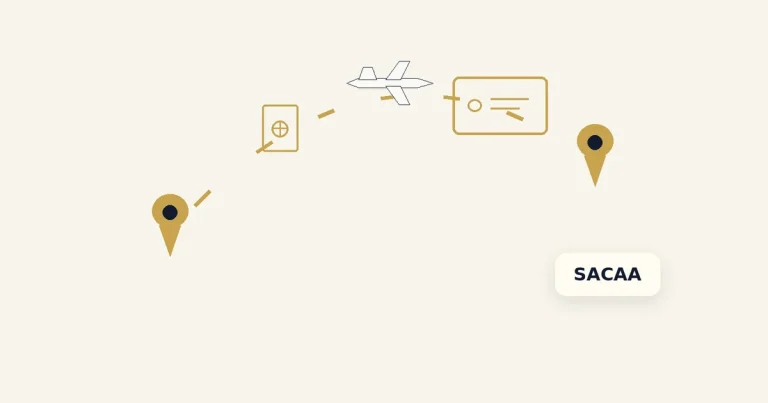
Admission and preparation procedures take place entirely in Egypt, and practical training takes place in South Africa under the South African Civil Aviation Authority (SACAA). The requirements for a woman are the same as for any student. The main ones are:
- Age between 17 and 30, and a secondary school certificate (general, Al-Azhar, or an equivalent such as IGCSE, the American Diploma or IB), or any four-year bachelor’s degree.
- English proficiency at B2 level (equivalent to ICAO Level 4). Anyone below that level takes an English course before traveling.
- Passing the medical exam: no chronic diseases, a hearing test, and normal color vision (an admission requirement at SkyTeam from the start). The final decision on medical fitness rests with the authorized Aviation Medical Examiner (AME), and standards vary by license class and issuing authority, so confirm them when you apply. Details of the exam and the rules on eyesight and glasses are in the aviation medical exam guide.
These requirements are explained in full, step by step, in the guide to aviation academy admission requirements, the complete reference for applying, for women and men alike.
Do women pilots get the same pay and opportunities as men?
Yes. Airline pilot pay is based on rank (first officer, then captain), flight hours and aircraft size, not gender. With the global pilot shortage, many airlines have adopted programs to increase the share of women in the cockpit. This opens opportunities for women graduates, although hiring requirements differ from one airline to another. To learn how a pilot’s income is made up and how it grows, read the pilot salary guide.
Support for female students during travel and study
Because practical training takes place in South Africa, SkyTeam makes sure each student’s trip is secure and organized from the first day:
- An academy escort stays with the student from the medical exam until travel procedures are finished.
- All English test and medical appointments are booked for you, and the full uniform is provided after measurements are taken.
- Medical insurance in South Africa covers hospital care at no cost to the student.
- The student is accompanied to the embassy, and the visa procedures are completed.
Does the cost of study differ between female and male students?
The cost is the same for everyone, with no difference between women and men. It depends on the program and the license you are aiming for, not on the student’s gender. You will find the full, updated breakdown in the guide to aviation study costs.
Frequently asked questions about aviation for women
Does a woman need a specific grade score to enter aviation?
No. No specific grade score is required, and a pass in secondary school is enough. What you actually need is to pass the medical exam and be proficient in English. Details are in the admission requirements guide.
Can a woman go into aviation straight after secondary school?
Yes, you can start right after secondary school, from age 17. General or Al-Azhar secondary certificates are accepted, as are equivalents such as IGCSE, the American Diploma or IB, and any four-year bachelor’s degree. You do not need a waiting year or a specific grade score. Passing secondary school is enough. If you hold a Gulf secondary certificate, ask the admissions team about its equivalency.
What are the minimum and maximum ages?
Applications are open from age 17 to 30, the same age range that applies to everyone.
Does color blindness or wearing glasses affect a woman's admission?
The answer is the same for women and men. Normal color vision is an admission requirement at SkyTeam from the start, so that the road to the commercial license stays open. Anyone who fails the color plate test takes a secondary test of air navigation colors. Glasses do not prevent admission: ICAO standards set no limit on visual acuity without correction. Your vision with glasses or lenses must reach the level set for each medical class, and the authorized Aviation Medical Examiner makes the final decision. The full explanation is in the aviation medical exam guide.
Talk to the admissions team and find out your own path to a license.