
What is a Night Rating?
The Night Rating extends the privileges of your Private Pilot License so you can fly at night, not just by day. It builds directly on the flying you already learned during your PPL and adds the specific skills, references and judgement that night operations demand.
It is usually the first rating a pilot adds after the PPL, because it opens up far more usable flying time and lays important groundwork for instrument flying later on.
All Programs
Explore every training path at Sky Team Aviation.
Flight Training Requirements
Your Night Rating totals 10 hours of dual flight, of which about 5 hours are instrument time, with the flight test included.
Examinations & Your Pilot Journey
To obtain your Night Rating, you must complete the required examinations. This milestone sits on a structured aviation career path.
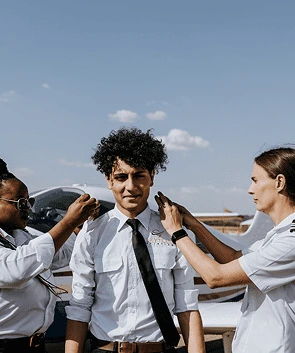
Night Check
A skill test with a designated examiner covering circuits, approaches and landings at night. One written theory subject is also required.
Your Path Beyond PPL
Your progression follows a structured pathway toward becoming a professional airline pilot.
Who Can Apply
To enrol in the Night Rating, you must hold the following prerequisite qualifications.
A valid Private Pilot License (PPL).
Class 2 medical certificate
English proficiency: ICAO English language proficiency, Level 4 minimum, is required.
Training fleet: Cessna 172, Piper PA-28, Beechcraft Baron 55, Diamond DA42.
Full requirements checklist
Hold a valid Private Pilot License (PPL).
Pass a practical flight test conducted by an authorised examiner.
Complete 10 hours of dual flight in total, of which about 5 hours are instrument time, flown on an approved simulator (such as an FNPT-II) and in an actual aircraft, typically a Cessna 172.
Your night flying is completed within these 10 hours and includes at least 5 night take-offs and landings and one night cross-country flight of at least 150 nautical miles with two full-stop landings at two different airports away from base.
The night skill test is conducted by an authorised examiner. It takes about an hour and is included within the 10 hours, so no additional hours are required.
Pass the official South African Civil Aviation Authority (SACAA) examination.
Meet the requirements? The next step is your application.
Check your eligibility and applySky Team in South Africa
A short montage from Sky Team Aviation Academy.
SACAA Night Rating Requirements
Night Rating training is delivered in South Africa, where the official examination is set and conducted by the South African Civil Aviation Authority (SACAA) — it is listed among the requirements on this page. Requirements are set by the authority and can change over time, and what a South African licence means for your own pathway depends on where you intend to fly. Confirm the current requirements with the SACAA, and with the authority that will issue or validate your licence.
What You Can Do With a Night Rating
The Night Rating extends your existing PPL privileges to include night operations.
Fly single-engine aircraft at night under VFR
Your existing day privileges are retained
Not granted by this rating alone
Personal use only; no paid flying
Student Accommodation
In this video, Sky Team explains how student accommodation is arranged.
Time to Complete
2 weeks–1 month
Your training timeline depends on how consistently you train and how quickly you progress.
Training frequency
Student availability
Weather conditions
Learning pace
Night Rating Cost for Students in Egypt & the Gulf
The cost of obtaining a Night Rating depends on your training pace, flight hours, and overall progression.
Your investment is tailored to your training plan.
Every student progresses differently, which means your total investment is influenced by how consistently you train and how efficiently you build your flight hours.
Get Your Personalized Cost Breakdown
Speak with our team to receive a clear, structured breakdown tailored to your training plan, no commitment required.
Request Pricing DetailsWhy Students Choose Sky Team
In this video, we explain why students choose Sky Team Aviation Academy.
Night Rating FAQs
Common questions about Night Rating training at SkyTeam Aviation.
Do I need a PPL first?
Are there extra written exams?
Can I fly for pay afterwards?
How long does it take?
What pilots earn — and why we will not print a number here
Pay is the question everyone arrives with, and it is the one where most of what you will read online is invented. There is no single pilot salary. What a pilot is paid depends on the airline, the aircraft, the seat, the hours flown in a given month and the country the contract is written in — and most of the figures circulating online name no source at all.
So this page will not print one. What we will say is what the Night Rating changes about your position: it lets you fly at night, which a private licence alone does not permit, and that is what moves you along the ladder that pay follows. We have written separately about how pilot pay is actually built up — basic, housing, flight-hour allowances — and why two pilots on the same licence can be paid very differently. Read that before you judge any number you are quoted.
Where this takes you
Sky Team is an admissions and placement office: we place students with a flight academy in South Africa, and the academy delivers the training under its own civil aviation authority. What you leave with is a licence recognised on that authority's terms — not a job offer, because no training provider anywhere can offer you one.
What the Night Rating does is open a specific door: it lets you fly at night, which a private licence alone does not permit. The next stage in Sky Team's training sequence is the instrument rating. We have Saudi students who have been through us and hold both the private and the commercial licence.
What comes after that is an airline's decision, not ours, and it turns on your hours, your ratings, your medical and your English. Anyone who tells you a training course comes with a seat at the end of it is selling you something we would not.
