
July 2026 · 9 min read · Sky Team Aviation Academy
Many students and parents mix up three completely different paths. An “aviation academy” is a licensed civil academy that qualifies you for pilot licenses. “Aviation college” is the popular name people usually use for the government-run Egyptian Aviation Academy. The “Egyptian Air Force College” is a military college under the armed forces. The requirements differ sharply between the three, and the real surprise is that getting into civil aviation is nothing like Tansik (Egypt’s national university placement system). This guide explains the real admission requirements as our admissions team at Sky Team Aviation Academy actually applies them, not the rumors going around.
What are the admission requirements for an aviation academy in Egypt? (Quick summary)
- •Age 17 to 30 years old
- •A Thanaweya Amma (secondary school certificate) or equivalent, with a pass and no set grade score
- •Passing the medical exam
- •English at B2 level or the equivalent of ICAO Level 4, with preparation available if you are below that
Admission requirements at a glance: age, qualification, language and medical exam
These are the basic requirements for joining a civil aviation academy. The sections below give the full details of each one:
| Requirement | What you need |
|---|---|
| Age | 17 to 30 years old |
| Educational qualification | A general or Al-Azhar secondary school certificate, or an equivalent certificate. A pass is enough, with no set grade score |
| Medical exam | No chronic diseases or color blindness, and sound hearing |
| English language | B2 level or Level 4 under ICAO standards, with preparation available if you are below that |
| Required documents | Your academic certificate, passport and personal photos, with the full list confirmed when you apply |
| Steps after applying | Medical exam, level test, and travel and study preparations |
Note that these are the requirements of private civil academies. The military Egyptian Air Force College and the government academy have different admission systems, which we explain in the section on the paths.

What grade score do you need to study aviation? The truth about grades and Tansik
The question we hear most from students after the secondary school results come out is “What grade score does the aviation college take?” The honest answer is that the question itself rests on a common mix-up. Civil aviation academies are not part of the Tansik office at all, and there is no “minimum grade score” to join them. At Sky Team Aviation Academy we don’t ask for any particular grade score. All you need is a pass in your certificate, because the real gates to aviation are age, the medical exam and your English level, not an exam mark.
So where does the confusion come from? From two other, completely different paths. One is the military Egyptian Air Force College, where admission is decided by military Tansik and strict age and fitness requirements. The other is the university aeronautical engineering colleges, which follow the engineering colleges’ Tansik and graduate an engineer, not a pilot. If your dream is to fly the aircraft yourself, your grade score is not what stands in your way.
For the full costs and installment options, see the guide to civil aviation college fees.
The requirements in detail: do you qualify?
The age you need to join an aviation academy
At Sky Team Aviation Academy we accept students from age 17 up to 30. The minimum age of 17 is tied to the requirements for issuing a private pilot license (PPL), and the maximum age for admission is 30.
Male students in Egypt should know one thing about military service: the academy handles the student’s military service deferment until age 25, and this deferment is available to anyone who enrolls before turning 22. In other words, your military service file won’t stop your dream if you start early.
Educational qualification: science or arts? And what about equivalent certificates?
This is exactly where the biggest myth about studying aviation falls apart. At SkyTeam we accept:
- The Egyptian secondary school certificate in all three streams: arts, science and maths
- The Al-Azhar secondary school certificate
- Equivalent certificates: the British IGCSE, the American Diploma and the International Baccalaureate (IB)
- Any bachelor’s degree from a four-year university program, if you have already graduated and want to change direction
In all of these cases, a pass is enough. We don’t require a set grade score in secondary school or a particular GPA in the American Diploma, and we never ask for SAT, EST or ACT tests. Our admissions team welcomes the arts stream just as it welcomes maths, because aviation sciences are taught from the start of the license path, not in secondary school. People who compare academies with engineering colleges tend to miss this: a pilot builds their science during training, not before it.
And if you have already finished university and decided a desk is not where you belong, a bachelor’s degree qualifies you to apply directly, whatever your major: commerce, law, engineering or anything else. As long as you are within the age limit of 30, switching to the cockpit is possible and realistic.
Students from the Gulf: ask the admissions team about the equivalency of your secondary school certificate when you apply, and they will tell you what authentication your country requires.
The aviation medical exam: what fitness do you need?
The medical exam is the first real gate for any pilot, and its aim is simply to confirm that your body can handle the flying environment safely. What gets checked? We make sure you have no physical defects that would get in the way of training, and no chronic diseases such as high blood pressure, heart disease or diabetes. We test your eyes’ ability to tell colors apart to rule out color blindness, because the cockpit relies on colored light signals, and we check that your hearing is sound.
Medical fitness in aviation comes in two classes, and knowing the difference will save you a lot of worry. Class 2 is enough for the private pilot license (PPL) and the night rating. Class 1 is required for the commercial license (CPL) and the advanced ratings that follow it. So a student starts with the lighter requirement and moves to Class 1 when progressing toward the commercial license.
Don’t let the intimidating name “medical exam” delay your decision. The exam isn’t looking for superhuman physical perfection, only for the specific disqualifying conditions we mentioned. The golden rule here: don’t assume you are unfit until the exam has had its say. Many common fears end at the first visit.
At SkyTeam we don’t leave you going from clinic to clinic alone. An academy representative stays with you at the medical exam from the first step until all the procedures are finished, as we explain in the application steps.
The English level you need (ICAO Level 4)
English is the global language of aviation, so you need at least Level 4 proficiency under the standards of the International Civil Aviation Organization (ICAO), which is roughly equal to B2 on the European scale. Note that what you need is not a specific language certificate but an actual level, measured by a placement test.
What does “Level 4” mean in practice? It means you understand and speak English with operational fluency: talking to the control tower, reading aircraft manuals and charts, and following theory lectures, which are all taught in English. That is why your level is tested before your studies start, not after. Here, language is a daily work tool, not a side subject.
And what if your level is below B2? That doesn’t close the door. We provide an English course that brings you up to the required level before you travel and start studying. The placement test itself takes place at IH, our partner center, and the academy books all your appointments.
Leave your details
An admissions advisor will call you back within 24 hours.
Ready to apply? Apply now →
Aviation academy admission requirements for women

This is the most searched question after the general requirements: do aviation academy requirements differ for women? The definite answer is no. Admission requirements are exactly the same for women and men, with no difference at all: the same age range of 17 to 30, the same pass-only rule from any stream, the same medical exam and the same English level. Civil aviation regulations don’t distinguish between the sexes in licensing requirements either.
A woman with a secondary school certificate or any equivalent applies through the same steps and goes through the same stages after applying, from the medical exam to the travel procedures. Her secondary school grade score doesn’t matter to us here either: an arts graduate is accepted exactly like a maths graduate. Flying is also one of the professions that has opened its doors most widely to women around the world, and women flying commercial aircraft stopped being an exception in this region’s skies years ago.
Even after applying, a female student goes through the same organized process as her classmates: the same support at the medical exam, the same placement test at the partner center, the same medical insurance during training and the same follow-up on visa procedures. The system is the same because the profession is the same.
Naturally, the same goes for men: there are no special requirements for any one group, and the rules above apply to everyone.
Documents you need to apply to an aviation college in Egypt
Prepare these basic documents before you apply:
- Your academic certificate (secondary school, equivalent or university degree)
- A valid passport
- Birth certificate
- Recent personal photos
The admissions team will give you the exact final list for your case when you apply, especially if you hold an equivalent certificate and may need extra authentication. Don’t put off applying because of one missing paper. Start the process and the team will guide you through the rest.
Admission steps and paths
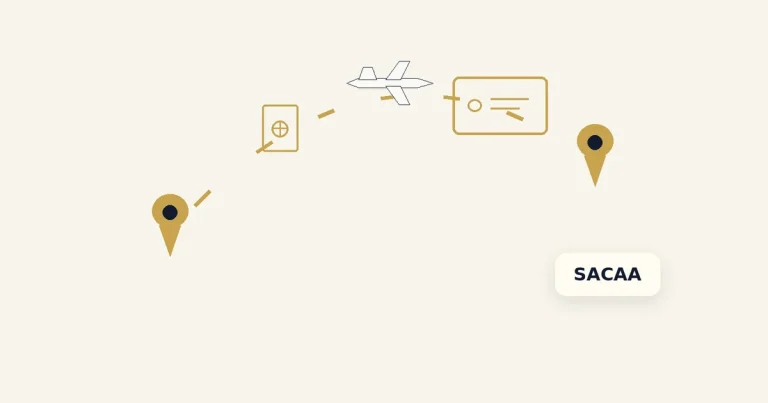
How to apply to an aviation academy, from first inquiry to travel
Requirements are one thing, and going through them is another. This is what actually happens for a student with us at SkyTeam after submitting an application:
This way, the student spends the time before travel preparing for the studies themselves, not running between offices and embassies. This arrangement is no luxury. The early stumbles in aviation training usually come from the procedures, not the studies, when a student finds out too late that a medical appointment was missed or an authentication paper is missing. Having one party manage the whole file from day one means all your energy goes where it should: into getting ready for your first lecture and your first flight hour.
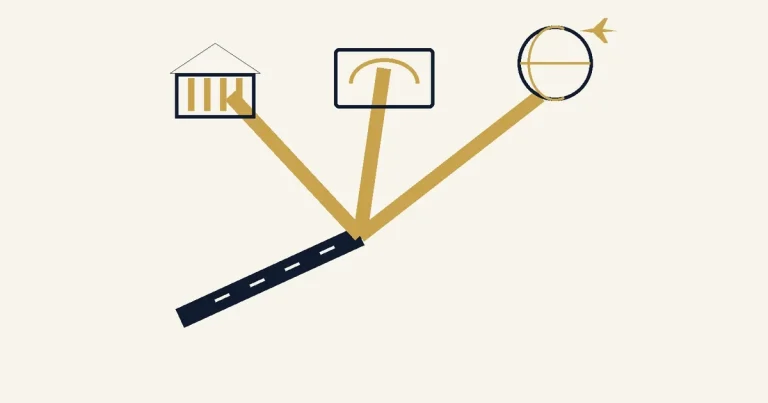
Paths to studying aviation in Egypt: government, military, private and international
So you can choose with your eyes open, here is a map of the four paths open to Egyptian and Arab students, and the requirements of each:
| Path | What it is | Main requirements | Who is it for? |
|---|---|---|---|
| Egyptian Air Force College (military) | A military college under the armed forces that graduates military pilots | Military Tansik and military entrance tests, a low maximum age, Egyptians only, and strict fitness requirements | Those who specifically want the military path and meet its narrow age requirements |
| Egyptian Aviation Academy (government) | The government academy under the Ministry of Civil Aviation, and usually what people mean by “aviation college” | Age from 17, a secondary school certificate or equivalent, a medical exam, an interview and a language test, with study inside Egypt | Those who prefer a government institution and want to study entirely inside Egypt |
| Private academies inside Egypt | Civil academies licensed by the Egyptian Civil Aviation Authority (ECAA) | Similar civil requirements: age, qualification, medical exam and English, with details that vary from one academy to another | Those who want a local civil path and are comparing the available programs |
| The international path with SkyTeam | Admission and preparation procedures are all completed in Egypt, with practical training in South Africa under the South African Civil Aviation Authority (SACAA) | Age 17 to 30, a pass in your certificate is enough, a medical exam, and English at ICAO Level 4 with a preparation course if needed | Those who want a license to international standards, clear flight hours and training on a varied fleet |
What sets the international path apart in practice? Complete clarity on the training numbers. Our private pilot license (PPL) is 60 flight hours in total, made up of 45 hours of dual training with an instructor and 15 hours of solo flight, and the commercial license (CPL) takes you to 200 total flight hours. Our students train on a varied fleet that includes the Cessna 172, Piper PA-28, Beechcraft Baron 55 and Diamond DA42, a mix of single-engine and multi-engine aircraft that makes a real difference to a pilot’s readiness. And if you missed the Egyptian Air Force College’s age or medical requirements, the civil path stays open to you until age 30.
Can you join an aviation academy after preparatory school?
Younger students and their parents ask this often, and the short answer is this: the civil aviation license path starts after secondary school or its equivalent, so there is no direct entry into an aviation academy after prep. What a prep student can do now is prepare wisely: choose a secondary school stream that suits them (any stream works, as we have seen) and invest seriously in English, because it will be their key later on. We will publish a full guide to the options after prep soon.
Frequently asked questions about aviation academy admission requirements
What are the requirements for entering an aviation academy?
There are four basic requirements: age 17 to 30, a secondary school certificate or equivalent with a pass and no set grade score, passing the medical exam, and English at B2 level or the equivalent of ICAO Level 4, with preparation available if you are below that.
What grade score does an aviation academy accept?
There is no grade score for admission to civil aviation academies, because they sit outside the Tansik system altogether. A pass in your certificate is enough, and what really decides it is the medical exam, your age and your English level.
What are the aviation academy requirements for women?
Exactly the same as for men, with no difference at all: age 17 to 30, a pass in secondary school or an equivalent from any stream, the medical exam and the required English level.
How many years of study does an aviation academy take?
The private pilot license (PPL) takes about 6 months, and reaching the commercial license (CPL) usually takes 12 to 18 months in total, depending on how regularly the student trains.
How do I apply to an aviation academy?
You start with an application and the basic documents, then the medical exam and the English placement test, and after that you move into the preparation stage for your studies. At SkyTeam the academy team goes with you through all of these steps until your visa is issued.
Is there an accredited aviation academy in Egypt?
Yes. There is the government academy and there are private academies licensed by the Egyptian Civil Aviation Authority (ECAA), plus the international path, where the student trains under an international aviation authority such as South Africa’s SACAA and earns a license to recognized ICAO standards.
If you are still comparing the institutions themselves before you decide, the guide to aviation academies in Egypt explains the types, the differences between them and how to verify accreditation yourself.
Does studying at an aviation academy have a future?
Civil aviation is a sector that keeps growing in Egypt and the Gulf, and demand is still there for qualified pilots with accredited licenses and strong English. The path takes commitment and seriousness, but it is a career with clear prospects for those who complete it. For the actual figures, see the guide How much do pilots earn in Egypt, Saudi Arabia and the Gulf.
Still have a question about admission requirements?
If you’ve read the requirements and they fit you, the next step is to get in touch. Our admissions team will review your case and reply to you in detail.