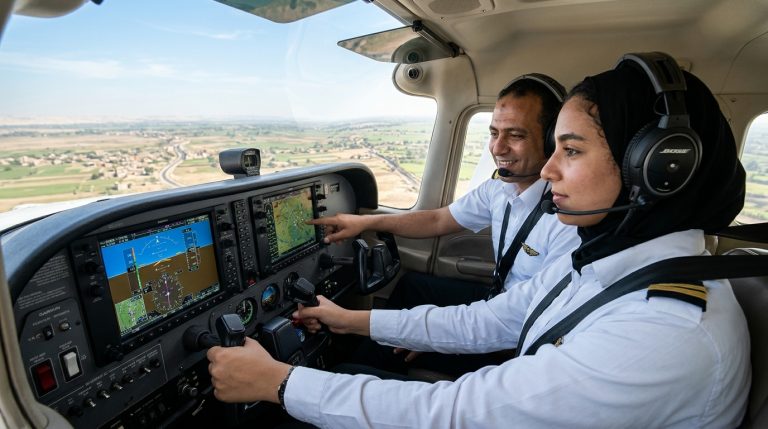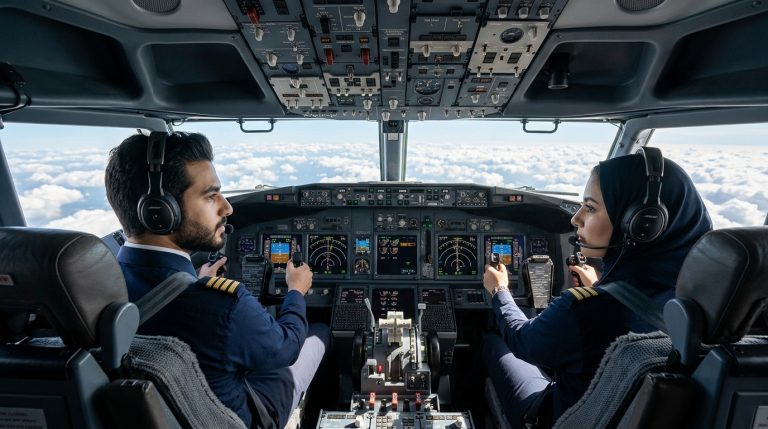
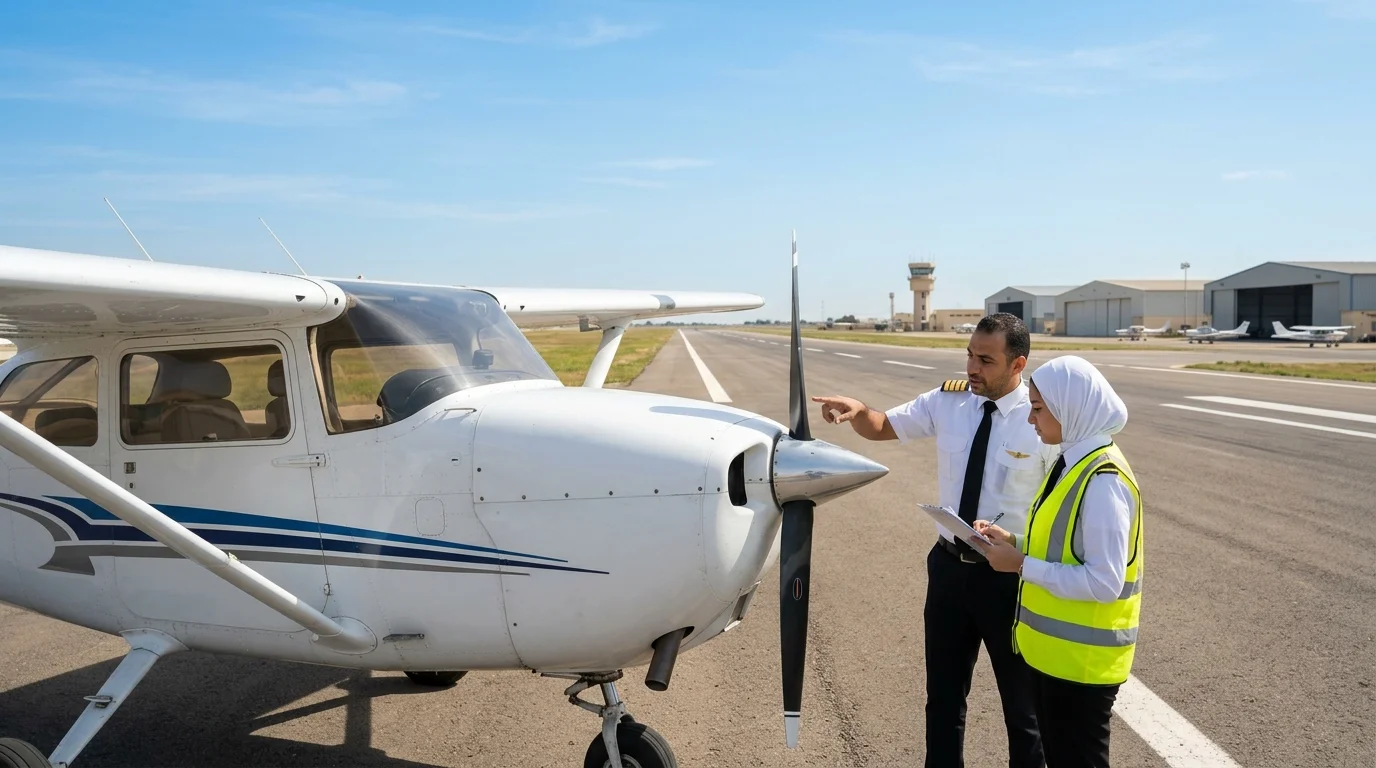
Aviation is the science, development, and operation of civil aircraft to transport passengers, cargo, and essential services safely across the globe. For ambitious students and supportive parents in Egypt and the Middle East, understanding the world of modern civil aviation is the first step toward launching an international career as a professional commercial pilot. At SkyTeam Aviation Academy, we guide you through every milestone of this journey, transforming a passion for flight into an accredited, professional qualification.
What Is Civil Aviation? Understanding the Industry Today
Civil aviation represents one of the most technologically advanced and vital sectors in the global economy. It encompasses all non-commercial-transport general aviation as well as commercial air transport services operated by regional and international passenger airlines. Across Egypt and the wider Middle East, expanding airline fleets, modern airport infrastructure, and flourishing global travel have created an exceptional demand for skilled flight crews who meet international safety standards.
To enter this dynamic field, an aspiring pilot must progress through dedicated theoretical ground school and practical flight training. Civil aviation authorities regulate every phase of this education under global frameworks established by the International Civil Aviation Organization (ICAO). This rigorous oversight guarantees that pilot certificates maintain their integrity, safety standards, and portability worldwide.
The Core Pathway: How Commercial Pilot Training Works
Becoming an airline pilot requires a step-by-step training curriculum structured to build confidence, technical competence, and aeronautical decision-making. At SkyTeam Aviation Academy, our comprehensive Commercial Pilot License (CPL) program takes approximately 18 months to complete, guiding students from their initial flight hours through to professional certification.
1. Ground School and Aeronautical Knowledge
Every aviator begins in the classroom. Ground school covers essential theoretical subjects including navigation, aviation meteorology, air law, human performance, aerodynamics, and aircraft systems. Mastering these topics ensures that a pilot understands the physical environment and regulatory guidelines governing every flight.
2. The Private Pilot License (PPL) Phase
The foundational practical phase takes about 3 to 6 months. During the PPL stage, student pilots learn basic flight maneuvers, emergency handling, takeoffs, landings, and their first solo flights. The PPL establishes solid stick-and-rudder skills and safe habits in the cockpit.
3. Building Flight Hours and Advanced Ratings
Following the PPL, students advance to instrument ratings and cross-country navigation, learning to fly safely using cockpit instruments in varied weather conditions. Multi-engine training introduces the complexity of managing higher-performance aircraft. By the time students finish their full commercial pilot course, they log around 200 flight hours.
Flight Training Program Overview
The following table outlines the structured progression students experience during their flight training journey:
| Stage | Approximate Duration | Core Objective | Key Milestone |
|---|---|---|---|
| Private Pilot License (PPL) | 3 to 6 months | Basic flight maneuvers, aircraft control, solo flight | First solo flight and PPL flight test |
| Hour Building & Navigation | 6 to 8 months | Cross-country flying, situational awareness | Solo cross-country navigation routes |
| Instrument & Commercial (CPL) | 4 to 6 months | Advanced instrument operations, complex systems | ~200 total hours & SACAA Commercial Pilot License |
International Licensing and Egyptian Equivalence
A primary consideration for students and families is license recognition. SkyTeam Aviation Academy conducts practical flight training through our partner flight school in South Africa (SACAA approved). The South African Civil Aviation Authority (SACAA) is a certified member state of ICAO, an international body comprising 193 member nations, including both South Africa and Egypt.
Converting Your License to the Egyptian Civil Aviation Authority
Because South Africa and Egypt are both ICAO member states, transferring your credentials to an Egyptian pilot license is a smooth and established process. Upon returning to Egypt, graduates take a conversion examination covering three country-specific subjects: Egyptian air law, meteorology, and navigation. Successfully completing these exams converts your qualification into an Egyptian Commercial Pilot License.
The conversion process is handled directly through the Egyptian Civil Aviation Authority. The fee for converting a South African CPL to an Egyptian CPL is set directly by the Egyptian Civil Aviation Authority and can change, so our advisors confirm the current amount. For graduates who pursue an advanced Type Rating on aircraft such as the Airbus A320 or Boeing 737-800 endorsed on their South African license, conversion is direct, with fees set by the authority.
Official University Degree Equivalence in Egypt
A major milestone for professional pilots in Egypt was established under Supreme Council of Universities (SCU) decision no. 210 (issued on 7 October 2024). By this decision, the Egyptian commercial pilot license (as well as flight instructor and ATPL licenses) issued by the Egyptian Civil Aviation Authority is officially equated to a higher university qualification (مؤهل عالي) under Egyptian Universities Law 49/1972.
To qualify for this university equivalence, the license holder must hold a General Secondary Certificate (Thanaweya Amma) or an accepted international equivalent. This official recognition allows our graduates to register for postgraduate university studies or adjust their academic standing in Egyptian universities alongside traditional college graduates.
Investment, Tuition Fees, and Living Costs
Transparency regarding the financial commitment of flight school is essential for family planning. SkyTeam Aviation Academy provides clear financial structures so you can plan your aviation education with complete certainty.
Tuition and Payment Structure
- Study Fees: 46,000 USD plus registration fees. This tuition covers the complete pilot training program and all internal flight examinations.
- Medical Supervision: The registration fees cover the official initial medical examination arranged and supervised by the academy; students pay no additional charges for this test.
- Flexible Installment Schedule: Families pay 22,000 USD across 3 installments prior to departure. The remaining balance is distributed over 12 months starting from the date of travel, resulting in an overall payment span of approximately 18 months from contract signing.
Personal Living Expenses Abroad
Personal living expenses—such as housing, food, local transport, international airfare, and pocket money—are separate from the 46,000 USD study fees. Living in South Africa remains very cost-effective compared to European or North American training locations:
- Average Monthly Expenses: An average budget of around 1,000 USD per month (which can range toward 1,200 USD or more depending on individual spending patterns) covers housing, food, pocket money, and local commuting.
- Academy Housing: Located in a secure compound close to essential services, students live next to the study location, and our advisors explain the housing details and costs. Accommodation features a two-bedroom apartment where each student enjoys an individual private bedroom and private bathroom, sharing only the kitchen and living room. Daily round-trip shuttle transportation between the accommodation and the airfield is included (utilities like water, electricity, and internet are paid separately).
Eligibility, Age, and Admission Requirements
Beginning your aviation career requires satisfying academic, medical, and language criteria. SkyTeam Aviation Academy offers flexible intake options across four terms each year—one every three months—allowing you to start when your travel arrangements are ready.
Educational and Age Criteria
- High School Certification: SkyTeam accepts students with the Egyptian Thanaweya Amma or any international secondary credential, such as American Diploma, IGCSE, GED, or secondary diplomas from Arab and foreign countries. For license conversion in Egypt, foreign certificates must satisfy the equivalence standards of the Egyptian Ministry of Education and Ministry of Higher Education.
- Early Enrollment: Students do not have to wait until completing secondary school. Early admission is possible from Grade 10 or Grade 11 depending on individual circumstances, and students can travel and begin their training during Grade 11.
- Travel Documentation: Egyptian male students must ensure standard travel paperwork, including an official military service deferment, is completed prior to departure.
Medical Examination Standards
Safety is the primary principle of aviation. Before final enrollment, students must undergo an official medical examination in Egypt arranged and supervised by SkyTeam. This is conducted at either Hasabo International Hospital or the medical commission (القومسيون الطبي) of the Egyptian Civil Aviation Authority. The examination checks for physical conditions that might impair flight safety, such as color blindness, keratoconus, severe uncorrected hearing problems, or serious chronic medical issues.
English Language Readiness
Aviation communicates in English globally. Student pilots must reach a minimum standard equivalent to ICAO Level 4 (approximately CEFR B1). For candidates who need to improve their language fluency before heading abroad, SkyTeam provides an intensive three-level English preparation course to ensure complete classroom and radio readiness.
Career Pathways After Flight School
The civil aviation sector across Egypt and the Middle East continues to experience steady demand for qualified first officers. While no responsible academy can guarantee automatic employment with a commercial airline, SkyTeam builds realistic, high-value career pathways for our graduates.
Flight Instructor Opportunities
One of the most proven strategies to build aeronautical experience is becoming a flight instructor. SkyTeam offers top-performing graduates the opportunity to work with the academy as certified flight instructors. This pathway allows dedicated pilots to log valuable pilot-in-command flight hours while preparing their applications for commercial airlines.
Airline Recruitment Support and Advanced Type Ratings
SkyTeam actively supports graduates by facilitating interview opportunities with approximately 10 partner airlines, matching candidates based on their total flight hours, instructor background, and certifications. For pilots seeking an accelerated track to the commercial flight deck, advanced Type Rating programs on popular jet airliners—specifically the Airbus A320 and Boeing 737-800—are available to make candidates immediately airline-ready.
Frequently Asked Questions About Aviation and Pilot Training
What is the tuition cost for the pilot program at SkyTeam Aviation Academy?
The study fees for the commercial pilot program are 46,000 USD plus registration fees. This amount covers the complete flight and ground training program as well as all required internal course examinations. The registration fees also include the supervised medical exam conducted in Egypt. Personal living expenses and housing are separate.
Is the pilot license recognized internationally and in Egypt?
Yes. Practical flight training is conducted through our partner flight school in South Africa (SACAA approved). Because South Africa and Egypt are both members of ICAO, your SACAA license is converted into an Egyptian Commercial Pilot License by passing three standard conversion exams in Egypt covering local air law, meteorology, and navigation.
Can high school students enroll before graduation?
Yes. Early admission is available starting from Grade 10 or Grade 11 depending on individual evaluation. Students are eligible to travel and begin their aviation training while in Grade 11, giving young pilots a head start on building their flight hours.
Does SkyTeam Aviation Academy offer cabin crew or flight attendant training?
No. SkyTeam Aviation Academy specializes strictly in professional pilot flight training and commercial pilot licenses. We do not provide cabin crew or flight attendant courses.
Can my pilot license be equated to a university degree in Egypt?
Yes. Under Supreme Council of Universities decision no. 210 (dated 7 October 2024), the Egyptian commercial pilot license issued by the Egyptian Civil Aviation Authority is officially recognized as equivalent to a higher university qualification (مؤهل عالي), provided the pilot holds a Thanaweya Amma certificate or its approved equivalent.
Take Your First Step into Modern Aviation
A career in civil aviation offers extraordinary professional growth, global travel, and daily intellectual challenge. Whether you are a student planning your future after secondary school or a parent exploring trusted educational investments for your son or daughter, SkyTeam Aviation Academy provides the structure, safety, and international accreditation you need.
Our team welcomes you to visit our administrative headquarters in Cairo at 108 Hassan Maamoun Street, Nasr City. Our advisors are available Sunday through Thursday from 10:00 AM to 6:00 PM to review your educational certificates, discuss installment plans, and schedule your medical assessment.
Ready to start? Discover your eligibility and apply now to speak with an admissions advisor at SkyTeam Aviation Academy today.