Last updated: July 2026 · 8 min read · Sky Team Aviation Academy
Before spending a single pound on flight training, there is one box every future pilot should tick first: the aviation medical exam. It is the question that worries applicants the most, and the one surrounded by the most myths. The reality is far friendlier than the rumours: most healthy applicants pass, glasses are allowed, and the whole process is more organised than a routine hospital check-up. This guide explains the two medical classes that matter to student pilots, what actually happens on exam day, the real eyesight rules, and where the exam is done in Egypt and in South Africa.
What is the aviation medical exam in Egypt, and who needs it?
The aviation medical is a structured assessment of your physical and mental fitness to operate safely in the air. It is not designed to fail you; it is a safety filter, because a pilot is responsible for lives. The standards come from Annex 1, Chapter 6 of the ICAO convention, which nearly every civil aviation authority implements through its own rules: Egypt through the Aeromedical Council of the Ministry of Civil Aviation, and South Africa through the SACAA under Part 67 of its Civil Aviation Regulations.
Almost everyone in aviation needs a medical certificate of some class: pilots and student pilots, cabin crew, and air traffic controllers. What changes between them is the class of certificate, which is what we cover next.
Class 1 medical exam vs Class 2: which one do you need?
The two classes that matter to a future pilot follow a simple rule: the more responsibility you carry in the air, the stricter the exam and the shorter its validity.
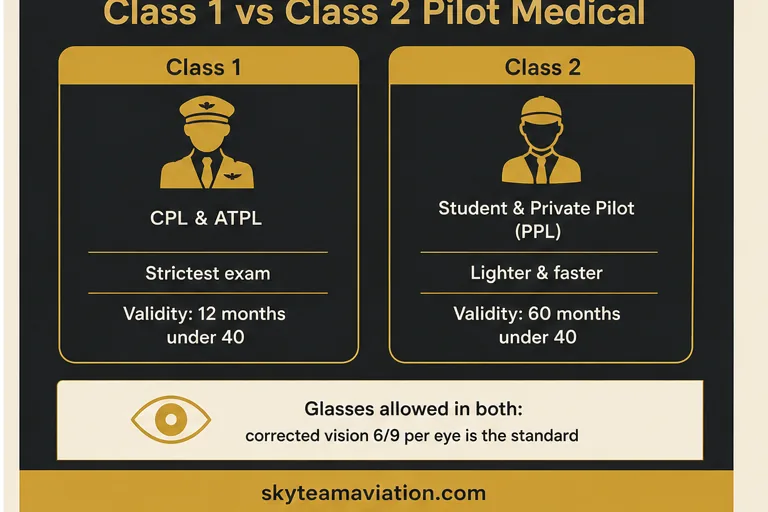
For the full picture, the international scheme also includes Class 3 for air traffic controllers, and in South Africa cabin crew fall under Class 2 per Part 67. As a student pilot, though, the two classes above are the only ones you need to think about.
The natural sequence for a Sky Team student: qualify for the student and private stages first, then hold a Class 1 from the Instrument Rating stage onwards, through the Commercial Pilot Licence (CPL) phase. Our practical advice is to take the Class 1 early even if you are just starting: if there is any medical finding, you want to know before you invest in training, not after.
What happens on exam day?
The exam is thorough but predictable, moving through clear stations:
- General clinical exam: height, weight, blood pressure, and a full physical check.
- Eyes: visual acuity (with your glasses if you wear them), colour perception with Ishihara-type plates, visual field, and in deeper exams a fundus check.
- Ear, nose and throat: a general check plus precise audiometry (hearing test).
- Heart: an ECG to confirm a healthy rhythm and heart muscle.
- Laboratory tests: blood and urine, including a drug screen, which is non-negotiable.
- Respiratory: lung function testing and sometimes a chest X-ray.
- Psychological and neurological review: history and questions confirming focus and stress tolerance.
From our students’ experience, the two systems feel different in practice. The Egyptian exam at the Aeromedical Council goes into more specialties: dermatology, dental and orthopaedic checks alongside the ECG, chest imaging, fundus and visual-field tests. The South African exam is practical and quick: a general physical, vision and hearing, and a drug screen. The initial Class 1 in South Africa is the fullest version, including a stress ECG and chest X-ray per SACAA requirements, and the periodic renewals after it are much lighter.
Eyesight and glasses: perfect vision is not required
This is the most damaging myth in pilot training, and it disqualifies people who were never disqualified. The documented ICAO standard is explicit: no limits apply to uncorrected visual acuity. What matters is your corrected vision: 6/9 in each eye and 6/6 with both eyes together for Class 1, and 6/12 in each eye with 6/9 binocular for Class 2. If you see well with glasses or contact lenses, you are almost certainly fine. Bring your glasses and your latest prescription to the exam, and if you have had laser eye surgery, South African practice requires a waiting period of 3 to 6 months before certification.
Two related questions students ask constantly:
- Colour vision: tested with colour plates; failing the initial plates leads to secondary testing of your ability to distinguish aviation navigation colours. On the Sky Team route we require sound colour vision from the start, so your path to the commercial licence stays unrestricted.
- Chronic conditions: insulin-treated diabetes is assessed as unfit under ICAO standards, while diabetes controlled by diet or tablets may be accepted with follow-up reports. That said, Sky Team’s initial admission screen requires freedom from chronic conditions such as hypertension, heart disease and diabetes, so if this applies to you, talk to the admissions team before any other step. A history of epilepsy or unexplained loss of consciousness is disqualifying. Above all, be completely honest on the medical history form: hiding information is far more dangerous to your licence than the information itself.
Where is the exam done in Egypt? The Aeromedical Council
In Egypt, the only officially authorised body for civil aviation medicals is the Aeromedical Council of the Ministry of Civil Aviation, located on the Cairo International Airport road in Salah Salem, Cairo. It examines pilots, student pilots, cabin crew and air traffic controllers, and keeps your medical file across your whole career. Booking is electronic through the ministry portal or by phone on 02 2268 8346 (exam centre: 02 2267 7610), working hours run 9:00 to 14:00, and the officially listed documents are simple: two recent photos plus a request letter from your training body, or a personal application on exam day. As a practical tip, carry your ID and bring your glasses with their prescription if you wear them. The official service page lists completion within one working day, with the administrative fees published on the portal.
And the exam in South Africa? The DAME system
In South Africa, where Sky Team students do their practical training, medicals are performed by Designated Aviation Medical Examiners (DAMEs) accredited by the SACAA, with Class 1 exams handled by Senior DAMEs. The system follows the same ICAO Annex 1 standards, exam records are valid for 90 days for certificate issue under Part 67, and the whole experience is efficient: the initial Class 1 is the most complete visit, and renewals are quick. You can see how the medical fits the bigger training picture in our guide to studying aviation in South Africa.
Where the medical step fits before training starts
At Sky Team Aviation Academy, the medical is not an obstacle you face alone; it is a scheduled step in the five-stage admission process, and the admissions team walks you through it: pointing you to the right class for your stage, reviewing your documents before the appointment, and following the result until your file is complete. That is also why we push every applicant to do the medical early, before any major financial commitment.
On cost, the honest answer is that the medical itself is one of the smallest lines in a pilot’s budget, and the official administrative fees are published on the ministry portal and change over time. The number worth planning for is the training itself, which we break down fully in how much it costs to be a pilot.
Frequently asked questions
What is an aviation medical certificate?
It is a mandatory fitness assessment for everyone working or training in aviation, from pilots and students to cabin crew and controllers. It follows ICAO Annex 1 standards, is issued through each country’s approved aeromedical body, and confirms you can perform aviation duties safely.
What is the difference between a Class 1 and Class 2 medical?
Class 1 is required for the Commercial Pilot Licence and airline flying; it is the strictest exam with the shortest validity, 12 months under age 40 under SACAA regulations. Class 2 covers student and private pilots, with a lighter exam and 60 months of validity under 40.
Can I become a pilot if I wear glasses?
Yes. ICAO sets no limits on uncorrected vision; your corrected vision must reach 6/9 per eye and 6/6 with both eyes for Class 1. Bring your glasses and prescription to the exam, and allow a 3 to 6 month waiting period after laser eye surgery, under SACAA guidance in South Africa, before certification.
Where do pilots take the medical exam in Egypt?
Only at the Aeromedical Council of the Ministry of Civil Aviation, on the Cairo International Airport road in Salah Salem, Cairo. Booking is electronic via the ministry portal, and the official service page lists completion within about one working day.
How much does the pilot medical exam cost?
The official administrative fees are published on the Egyptian ministry portal and are updated over time, so always check the official service page or ask the admissions team when booking. In every case the medical is a minor cost next to training itself.
How long is a pilot medical certificate valid?
Under South Africa’s Part 67 regulations: Class 1 is valid 12 months under age 40, shortening with age; Class 2 is valid 60 months under 40, then 24 months after 40 and 12 months after 50, measured from the end of the month of issue.
Do diabetes or colour blindness disqualify you from flying?
Insulin-treated diabetes is assessed as unfit under ICAO standards, while diet- or tablet-controlled diabetes may be accepted with periodic medical reports; note that Sky Team’s initial admission screen requires freedom from chronic conditions, so speak to the admissions team first if this applies to you. Colour vision is tested with colour plates; those who fail the plates can take a secondary test of their ability to recognise aviation colours. On the Sky Team route we require sound colour vision from the start so the commercial path stays unrestricted.
Ready to take the first step toward the flight deck? Book your medical early, and let the admissions team walk you through every step, from the appointment to your first day on the runway.