Last updated: July 2026 · 10 min read · Sky Team Aviation Academy
Where to Study Aviation in South Africa
If you want to fly for a living, the place you actually study is a SACAA-approved flight training academy, not a college lecture hall. These academies (formally called Approved Training Organisations) take you through the licence ladder step by step: first a Private Pilot Licence, then hour building, then the Commercial Pilot Licence that lets you be paid to fly. The whole path runs under one regulator, which is exactly what gives a South African licence its weight abroad.
The single most important thing when choosing where to study is to confirm the academy is genuinely SACAA-approved. The regulator itself warns about organisations advertising pilot training without approval, so approval status, aircraft condition, and instructor credentials matter far more than marketing. A recognised training structure is the reason many international students, including students from Egypt and the Gulf, choose the country in the first place.
Is Pilot Training in South Africa at a University or a Flight School?
This is the question that confuses most people searching for “which university to study pilot in South Africa,” so let us answer it plainly: becoming an airline pilot is not a university degree. In South Africa, and almost everywhere else, professional pilot licences are earned at flight academies regulated by the civil aviation authority, not at degree-granting universities. Some universities do offer aviation management or aeronautical science degrees, but those prepare you for the industry around flying, not for the licence that puts you in the cockpit.
So if your goal is to sit in the flight deck, you are looking for a SACAA-approved flight school, not a university faculty. This distinction saves you time and money: you do not need a high school average high enough for a competitive university programme, because the real entry gates to flying are your medical, your English, and your commitment, not a university admission score.
How Much Does It Cost to Study Aviation in South Africa?
Cost is usually the deciding factor, and it is South Africa’s strongest card. Training there is clearly cheaper than the traditional Western destinations: programmes in the United States, the UK, Australia, and Canada can cost roughly double what a student spends in South Africa to reach the same licence, while the accreditation and quality stay the same. The saving comes from lower operating and living costs, not from lower standards, so you pay less for the same flight hour, not for less training.
Because prices vary by academy and change over time, we do not quote a fixed number here that could go stale. For a full, current breakdown of the cost of becoming a pilot and how it builds up stage by stage, see how much it costs to be a pilot. When you compare countries, compare the total cost all the way to the Commercial Pilot Licence, including living expenses, not the price of a single stage, and South Africa usually wins that comparison.
How Long Does It Take?
Reaching the Commercial Pilot Licence (CPL) usually takes about 12 to 18 months for a student who trains full time and consistently. That figure is the sum of several stages, each with its own hours and tests:
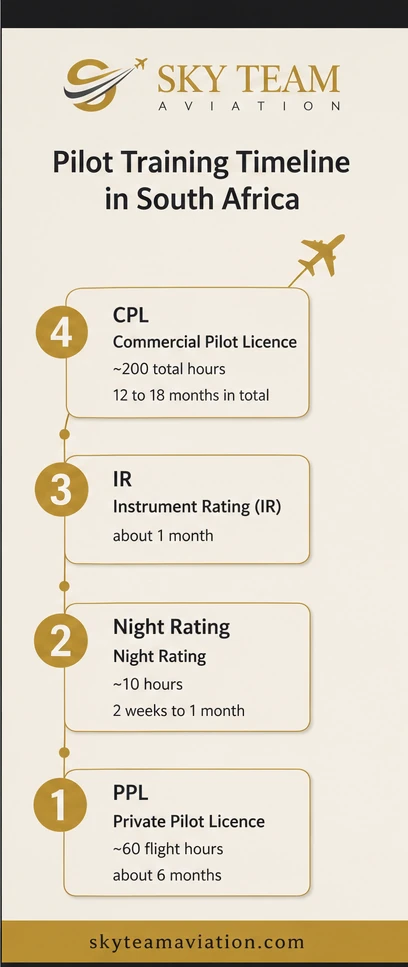
Weather is the biggest reason the timeline is predictable. South Africa offers a large number of clear flying days per year, often more than 250, so training stops less often than in destinations with long winters, and progress is faster. The other two factors are simple: how consistently and full-time you train, and whether you clear the theory exams and medical on schedule. The 12-to-18-month figure describes a focused, full-time student, and it is realistic rather than a promise.
Entry Requirements
The requirements to start pilot training are simpler than most people expect, because they are professional standards rather than academic scores:
- Age: you can begin from 17 for the Private Pilot Licence. Our academy accepts students up to age 30.
- Education: a secondary school certificate or equivalent. A high average is not required; the real gates are the medical, English, and your commitment.
- English: a level equivalent to B2 or ICAO Level 4, since all training is in English. Students below that level take an English course before travelling.
- Medical: passing the aviation medical, with the Class 1 certificate required for the commercial licence. The key points are freedom from chronic illness and colour blindness, and adequate hearing.
- Study visa: South Africa grants student visas for flight training relatively smoothly, requiring acceptance from an approved academy and proof of funds.
Are Pilots in Demand in South Africa?
Global aviation has faced a long-running need for qualified pilots as fleets grow and experienced crews retire, and that broad demand is part of why the profession pays well. Within South Africa, the training sector is active and the country attracts students from across Africa and the Middle East, while graduates commonly look beyond the local market to regional and international carriers and to cargo operators.
The honest framing is this: job prospects depend far more on your licences, your logged flight hours, and your English than on where you trained. A recognised licence and a clean, growing logbook are what open doors, and South Africa is a cost-effective place to build both. You can read how pay grows with rank and hours in our guide to what a commercial pilot does.
The Real Pros and Cons
An honest guide has to show both sides. Here is the cleanest summary of the trade-offs.
Pros
- A recognised training structure. SACAA oversight covers licensing, training standards, and verification of approved organisations, giving you a stronger reference point when comparing schools.
- Weather supports flying continuity. More clear days mean fewer cancelled lessons and steadier progress toward your hours.
- Lower total cost. Training and living costs are both lower than Western destinations, for the same internationally recognised licence.
- English-medium training in a busy, varied airspace that prepares you for real operations and airline interviews.
Cons
- Not every school is equal. You still have to verify the academy properly; approval exists, but not every provider is the right fit, and the SACAA warns about unapproved organisations advertising training.
- International relocation. Studying abroad means visas, accommodation, and time away from home, which is exactly the part a good academy should handle for you.
- Licence conversion. Working in another country later can require a conversion process, which varies by state and is worth checking early for your target market.
Who Should Consider It, and How SkyTeam Fits
South Africa makes the most sense for students who want a balance of cost awareness, real flying opportunity, and full-time aviation focus, and who are planning beyond the first licence toward a long career. The best training decision is rarely the cheapest single step; it is the route that keeps progressing all the way to a recognised commercial licence.

That is where Sky Team Aviation Academy fits. Sky Team was built to be the bridge for Arab and international students into South African training: a SACAA-approved path from the Private Pilot Licence to the Commercial Pilot Licence, with the academy handling the medical, the English placement, the uniform, medical insurance in South Africa, and the visa process alongside the student, plus Arabic-speaking support throughout. In short, you are not buying flight hours alone, you are buying an organised route from your home country to the flight deck, with the details that overwhelm a solo applicant taken care of.

Frequently Asked Questions
Where do you study to become a pilot in South Africa?
At a SACAA-approved flight training academy, not a university. These academies take you from the Private Pilot Licence through hour building to the Commercial Pilot Licence under one regulator, which is what makes the licence internationally recognised.
Can I study to be a pilot at a university in South Africa?
Professional pilot licences are earned at flight academies, not degree-granting universities. Some universities offer aviation management or aeronautical science degrees, but to fly for an airline you need a flight school licence, not a university degree.
How much does it cost to study aviation in South Africa?
It varies by academy and stage, but it is generally far cheaper than the United States, the UK, or Australia for the same recognised licence. Because prices change, see our full breakdown of how much it costs to be a pilot rather than relying on a single quoted figure.
How long does pilot training in South Africa take?
Reaching the Commercial Pilot Licence usually takes about 12 to 18 months for a full-time, consistent student, spread across the Private Pilot Licence, Night Rating, Instrument Rating, and the roughly 200 total hours the CPL requires.
Are pilots in demand in South Africa?
Aviation has a long-running global need for qualified pilots, and South Africa trains many local and international students. Actual job prospects depend on your licences, logged hours, and English more than on where you trained.
Is a South African pilot licence recognised internationally?
Yes. SACAA issues licences to ICAO standards that are recognised in more than 190 countries and are convertible in many states. Conversion steps vary by country, so check the process for your target market when you apply.
What are the entry requirements?
You can start from age 17, with a secondary certificate, an English level equivalent to B2 or ICAO Level 4, a Class 1 aviation medical, and a study visa. Students below the English level take a preparatory course before travelling.
The bottom line: South Africa gives you an internationally recognised licence at a lower cost and a predictable timeline, and the difference between reading about this route and starting it is one decision and the right support along the way.
Start your path to the flight deck
Ready to take the first step toward the flight deck? Apply now and our admissions team will walk you through every question.