Instrument Landing System: How Pilots Use It in Low Visibility
An Instrument Landing System helps pilots land more accurately when visibility is reduced and outside visual references are limited. It provides approach guidance by combining lateral and vertical information, which is why it is especially important in instrument conditions and low visibility. The FAA explains on its Instrument Landing System overview that the system provides precision approach guidance using a localizer for lateral guidance and a glide slope for vertical guidance.
For student pilots, this matters because the runway environment can disappear quickly in cloud, haze, rain, or darkness. When that happens, cockpit discipline matters more than intuition, which is one reason flight instruments become so important as training progresses. A precision approach is not just about “finding the runway.” It is about arriving on the correct path, at the correct height, and with enough stability to continue safely.
What an Instrument Landing System actually consists of
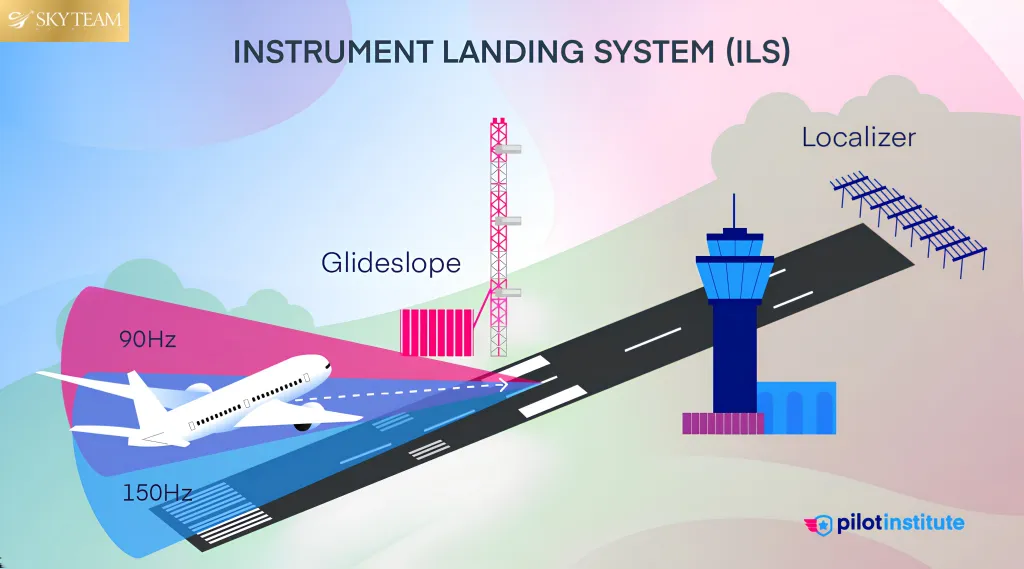
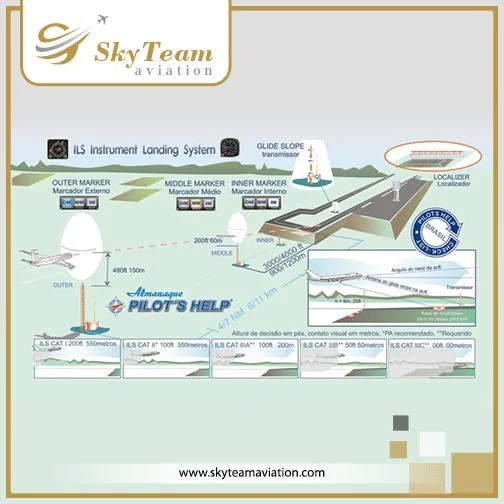
The Instrument Landing System is built around two main guidance elements: the localizer and the glide slope. In the FAA’s AIM, the localizer gives alignment guidance with the runway centerline, while the glide slope provides the vertical descent path toward the runway. Together, they create a precision approach path rather than leaving the pilot to visually judge alignment and descent angle.
That is what makes this approach aid different from simpler navigation help. It is not only telling the pilot where the runway is. It helps the aircraft stay aligned with the centerline and descend on the proper vertical path toward the touchdown area. In practical terms, that reduces guesswork during a phase of flight where small errors can become serious very quickly.
Localizer: staying lined up with the runway
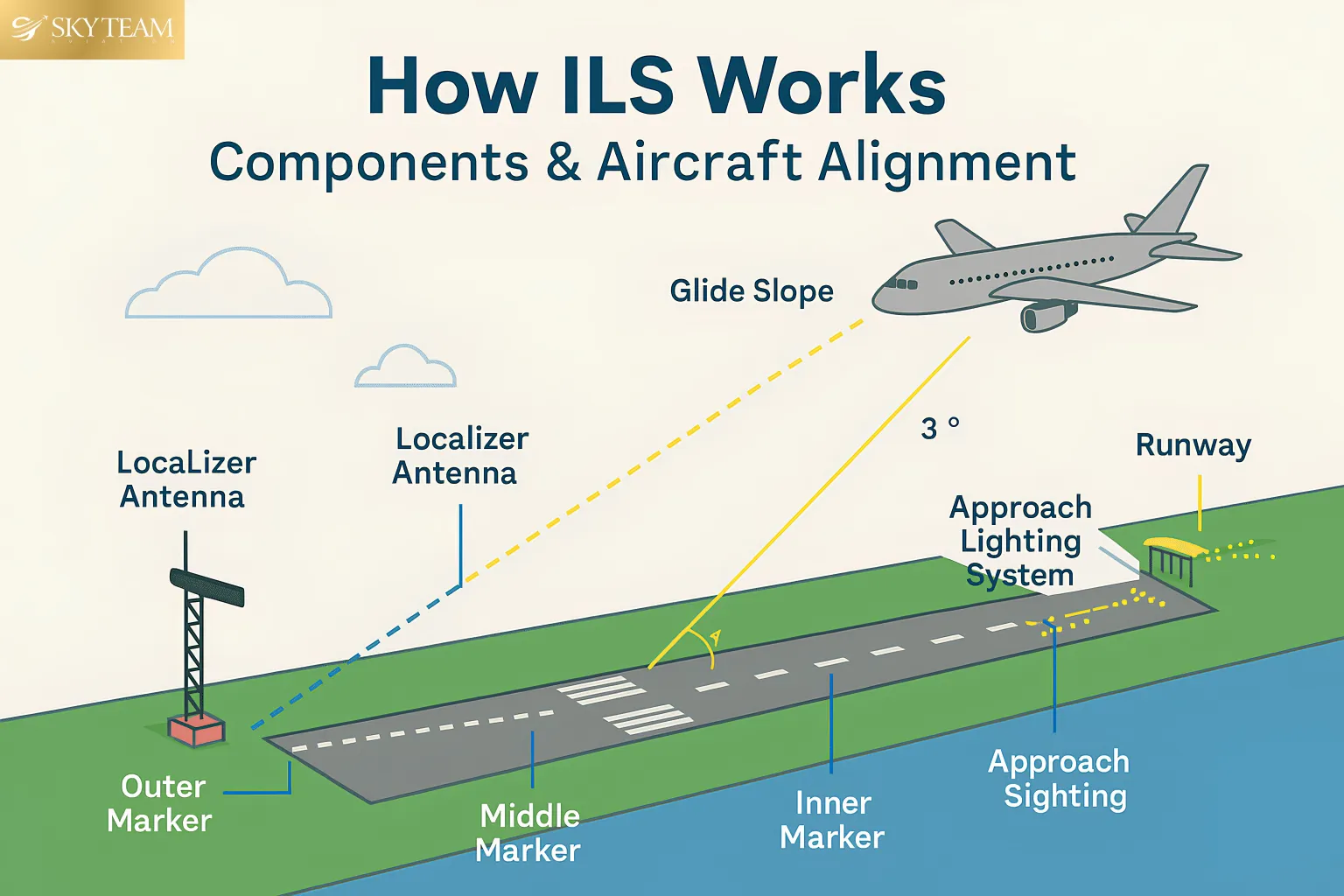
The localizer gives lateral guidance. In simple terms, it helps the pilot stay aligned with the runway centerline rather than drifting too far left or right on final approach. The FAA’s AIM states that the localizer is one of the basic components of the system and is used for precise alignment with the runway.
This matters because alignment errors near the runway are not small problems. A pilot who is unstable laterally may be forced into a poor landing attempt, a late correction, or a go-around. The localizer makes the approach more disciplined by providing a reliable directional reference rather than relying solely on outside judgment.
Glide slope: arriving on the right descent path
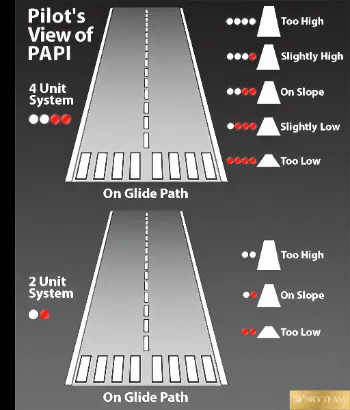
The glide slope gives vertical guidance. It helps the pilot descend at the intended angle, rather than arriving too high, too low, or too steeply. The FAA’s ILS page notes that the glide slope transmits UHF signals to provide vertical guidance for a controlled descent to the runway.
That is why the glide slope matters so much in poor visibility. A pilot may not be able to judge visually whether the aircraft is trending high or low until very late. With proper vertical guidance, the approach becomes more stable and more predictable, which is exactly what a pilot needs when outside cues are weak.
Why the Instrument Landing System matters in poor visibility
The Instrument Landing System is most valuable when the outside environment does not provide the pilot with enough help. Low cloud, rain, haze, or darkness can make visual judgment unreliable, and a precision approach system helps replace that uncertainty with structured guidance. The FAA’s Instrument Procedures Handbook states that instrument approaches can be especially challenging during low-visibility operations, which is exactly where this guidance becomes operationally important.
This does not mean the system “lands the aeroplane for the pilot.” It means it gives the pilot a much more reliable path to follow. The approach still requires disciplined flying, correct configuration, good instrument scan, and proper decision-making. But without this kind of support, the margin for error in bad visibility would be much smaller.
Why pilots trust precision guidance more than outside guesses
When visual references disappear, a pilot can no longer rely on the runway picture to judge every correction early. The instrument indications become more important than the outside view until the required visual references are acquired. That is one reason ILS training sits so close to the broader instrument discipline, and why pilots progressing toward an Instrument Rating spend so much time learning to trust and cross-check the panel properly.
It also explains why this kind of approach is not just a technical topic. It is a workload-management topic. The more clearly the pilot understands the guidance, the less mental effort is wasted on reconstructing the approach path from partial visual cues.
What pilots usually check before using it
A precision approach does not begin at the final approach fix. It begins with preparation. The pilot must verify frequencies, identify the aid, brief the approach, set altitudes, understand the minima, and make sure the aircraft is configured in time. The FAA’s Aeroplane Flying Handbook emphasises using the aircraft’s pre-takeoff and procedural checklists, precisely because a disciplined setup protects the pilot from rushed mistakes later in flight.
This is why approach setup belongs in the same mindset as checklist discipline on the ground. A pilot who understands the value of a takeoff checklist usually becomes better at structured approach preparation, too, because both are really about doing the important things in the right order before workload spikes.
The basics pilots want to be ready before the approach
| Correct localizer frequency set and identified | Confirms the aircraft is tracking the right facility |
| Correct inbound course selected | Supports proper runway alignment |
| Approach altitude and minima briefed | Prevents late confusion on descent |
| Aircraft configured on time | Reduces unstable approach risk |
| Missed approach understood | Gives the pilot a safe backup plan |
Those checks matter because approach errors are rarely caused by one dramatic mistake. More often than not, they stem from small setup problems that build on one another. Good preparation makes the approach feel quieter, clearer, and easier to manage.
How pilots read the guidance in the cockpit
Once established on the approach, the pilot is basically trying to keep both guidance indications centred or properly corrected. If the lateral guidance starts moving, the aircraft is drifting away from the centerline. If the vertical guidance moves, the aircraft is getting above or below the desired descent path. That is why instrument scan stays so important all the way to decision altitude or the missed approach point.
This is also where overcontrol becomes dangerous. The goal is not to aggressively chase every tiny movement. The goal is to make measured corrections and keep the aircraft stable. Precision guidance helps most when the pilot flies it calmly and early, rather than waiting until the indications move too far and then trying to fix everything at once.
Common mistakes pilots try to avoid
- Waiting too long to correct localizer drift
- Chasing the glide path with abrupt pitch changes
- Becoming so focused on one indication that the overall scan breaks down
- Arriving on final, not fully configured or properly briefed
These are not minor issues. A good precision approach depends on rhythm, discipline, and on anticipating deviations early rather than reacting late.
Why this system still matters even with modern avionics
Modern aircraft may also use GPS-based or other advanced approach technologies, but ILS remains one of the best-known and most widely trusted precision systems in aviation. The FAA continues to maintain specific siting, service, and critical-area requirements for these installations, which shows that they still matter operationally.
That matters because pilots are not only learning history when they study ILS. They are learning a precision-approach concept that still shapes how instrument flying is taught and flown. Even when avionics become more advanced, the discipline behind localizer-and-glide-path flying remains highly relevant.
Conclusion
The Instrument Landing System remains one of the clearest examples of how aviation turns a difficult phase of flight into a more structured one. The localizer keeps the aircraft aligned with the runway centerline, and the glide slope helps the pilot descend on the intended vertical path. Together, they make low-visibility approaches more controlled, more repeatable, and safer when flown correctly.
After that point, pilots usually shorten the name to ILS, but the idea stays the same: precise lateral and vertical guidance during one of the highest-workload parts of the flight. For any pilot moving deeper into instrument flying, understanding how it works is not optional. It is part of becoming genuinely competent in poor-weather operations.