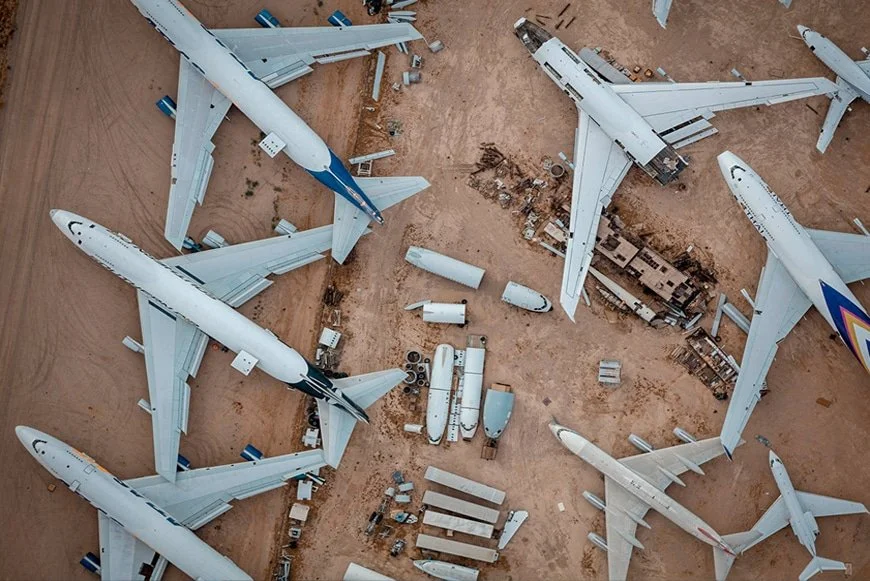
An aircraft’s life is not measured the way people usually measure the life of a car or a building. In aviation, Aircraft Lifespan is tied much more closely to use, stress, and inspection history than to the number of calendar years since delivery. One of the biggest factors is the number of flight and pressurisation cycles the aircraft has experienced, because every takeoff, landing, climb, descent, and cabin pressurisation event puts structural stress into the airframe. EASA’s ageing-aircraft rule describes these risks as including fatigue of the basic type design, widespread fatigue damage, corrosion, fatigue of repairs and changes, and continued operation with unsafe levels of cracking.
That is why two aircraft built in the same year can age very differently. A short-haul aircraft that cycles multiple times per day may accumulate structural fatigue much faster than a long-haul aircraft that flies fewer sectors. FAA and Boeing materials both point to pressurisation cycles and repeated loading as core fatigue drivers in transport aircraft structures.
Why cycles matter more than age

Each time a pressurised aircraft climbs, and the cabin is pressurised, and then later descends and depressurises, the fuselage and other structural areas are loaded and unloaded again. Over many cycles, repeated stress can lead to fatigue cracks, especially around joints, fastener holes, repairs, and other stress-concentration points. EASA explicitly identifies fatigue and widespread fatigue damage as key risks for ageing aircraft.
This is one reason Aircraft Lifespan should never be simplified into “old aircraft are unsafe” or “new aircraft are safe.” The real question is whether the aircraft has been maintained, inspected, repaired correctly, and operated within a structural integrity programme. In aviation, age alone is never the whole story.
What actually shortens an aircraft’s lifespan?
There is no single reason an aircraft wears out. Aircraft ageing is usually the result of multiple forces working together over time: fatigue, corrosion, environmental exposure, maintenance quality, operational tempo, and the aircraft’s original design.
The biggest structural threats
The most important threats to long-term airframe life are usually:
|
Lifespan factor |
What it does to the aircraft |
Why it matters |
|---|---|---|
|
Pressurization cycles |
Repeatedly loads and unloads the fuselage |
Drives fatigue in high-cycle aircraft |
|
Takeoff and landing cycles |
Adds structural and operational stress |
Short-haul fleets accumulate these quickly |
|
Corrosion |
Weakens materials over time |
Especially important in harsh environments |
|
Fatigue at joints and fasteners |
Can initiate cracks |
Common in highly loaded structural areas |
|
Repairs and modifications |
Can change local stress patterns |
Must be managed under damage-tolerance rules |
|
Poor maintenance discipline |
Allows defects to grow unnoticed |
Turns manageable issues into safety risks |
EASA’s ageing-aircraft material and FAA repair-assessment guidance both emphasise fatigue, corrosion, repairs, and crack growth as central structural risks that must be controlled through continued airworthiness and inspection programmes.
Why do the fuselage and wings get so much attention
The fuselage matters because pressurisation cycles repeatedly load the pressure shell, especially around fasteners, lap joints, doors, and other structural transitions. The wings matter because they constantly carry lift loads and fuel loads, and endure repeated bending forces. Boeing’s structural-fatigue material notes that pressurisation-cycle testing and damage-tolerance evaluation are core parts of structural integrity work.
That is why Aircraft Lifespan is closely tied to aircraft structure. If you do not understand how the aircraft is built, it is much harder to understand why certain areas age faster, why inspections focus on specific zones, and why some fleets are retired earlier than others.
How do airlines know whether an aircraft is still healthy?
Airlines do not rely on guesswork. They rely on manufacturer maintenance programmes, regulatory requirements, and increasingly sophisticated inspection methods designed to detect problems before they become dangerous. FAA rules and guidance around repair assessment, ageing aircraft, and damage tolerance exist because structural deterioration must be found early, not after failure.
This is where the idea of Aircraft Lifespan becomes much more practical. It is not only about how long the metal lasts. It is about whether the inspection and maintenance system is strong enough to find fatigue and cracking while they are still manageable.
The role of non-destructive inspection
Modern aircraft are inspected using non-destructive evaluation methods so engineers can look for defects without cutting the aircraft apart. Ultrasonic methods, phased-array testing, and other NDT techniques are used to detect subsurface flaws, crack growth, and hidden damage in critical areas. FAA and industry guidance around fatigue and structural integrity repeatedly treat NDT and repeated-load evidence as central tools in keeping aircraft in service safely.
This matters because many structural problems start small. A crack around a fastener hole may be tiny at first, but left alone it can grow. Good inspection programs are what stop a small flaw from becoming a fleet-level problem. That is one reason Aircraft Lifespan is as much about inspection quality as it is about original design.
Can an aircraft stay in service for decades?
Yes, it can. A well-designed aircraft can remain in service for a very long time if its maintenance, inspection, repair, and operating history all support continued structural integrity. EASA’s ageing-aircraft framework exists specifically because large aeroplanes may continue operating safely well into later life if ageing risks are actively managed.
The important point is that long service life is never automatic. It has to be earned through continued airworthiness work, inspections, damage-tolerance management, and sometimes part replacement or structural upgrades.
A simple way to think about aircraft longevity
|
Aircraft condition |
Likely effect on lifespan |
|---|---|
|
High cycles + weak maintenance |
Lifespan shortens faster |
|
High cycles + strong inspection programme |
Lifespan may still be extended safely |
|
Lower cycles + good maintenance |
Often supports a longer service life |
|
Corrosion-prone environment + poor control |
Structural ageing accelerates |
|
Major repair history + strong follow-up |
Continued service possible, but the inspection burden rises |
That table is the simplest way to understand Aircraft Lifespan. The aircraft does not survive because it is lucky. It survives because the structure, maintenance system, and regulatory oversight continue working together over time.
Why this matters to pilots, not just engineers
It is easy to think lifespan is only an engineering topic, but pilots benefit from understanding it too. Pilots operate aircraft that are maintained according to these structural rules, and professional pilots should understand why inspections, maintenance delays, MEL decisions, and structural limitations are taken so seriously.
Lifespan awareness is part of professional aviation thinking
A pilot does not need to become a structural engineer, but they should understand that an aircraft’s age is tied to use, cycles, and maintenance history, not just the delivery date. That broader aviation awareness is part of what separates casual interest from professional understanding. It is also one reason an advanced pathway like the A320/B737 NG type rating makes sense in this wider conversation, because more advanced aircraft operations demand a more mature understanding of how real transport aircraft are managed in service.
A related concept also connects back to the airport and ground infrastructure. Aircraft do not age only in the air; they also age in operational systems, including inspections, parking, handling, and maintenance environments at airports and aerodromes. The aircraft’s lifespan is shaped by where and how it operates, not just how it was built.
A more compelling way to read aircraft lifespan
The table below gives the clearest big-picture view:
|
Question |
Short answer |
|---|---|
|
Is aircraft lifespan mainly about years? |
No, it is more about cycles, stress, and maintenance history |
|
What part is most fatigue-sensitive? |
Often, the fuselage pressure shell, but wings matter too |
|
Can old aircraft still be safe? |
Yes, if managed correctly through inspection and maintenance |
|
What keeps aircraft in service longer? |
Strong design, lower cycle stress, good repair quality, disciplined inspection |
|
What ends aircraft life faster? |
Heavy cycling, corrosion, poor maintenance, and unmanaged fatigue damage |
That is the real story of Aircraft Lifespan. Aircraft do not “expire” in a simple way. They are continuously judged by how they have been used, what damage they may have accumulated, and whether the structure is still being managed safely.
Conclusion
Aircraft Lifespan is really a story about fatigue, cycles, inspections, and structural discipline. Pressurisation cycles, takeoffs, landings, corrosion, and crack growth all affect how long an aircraft can remain in service, and regulators like the FAA and EASA have built ageing-aircraft frameworks around exactly those risks.
So the most honest answer is this: an aircraft lasts as long as its structure, inspection regime, maintenance quality, and operating history allow it to last safely. That is what makes the subject so compelling. It is not really about age. It is about how engineering, operations, and maintenance fight time together.