Commercial Pilot Responsibilities and Benefits

Commercial aviation attracts people for obvious reasons: flying, travel, career progression, and the chance to work in a field that carries real responsibility. But once someone moves beyond the dream and starts looking seriously at the path, the question becomes more practical. What does a commercial pilot actually do, what responsibilities come with the role, and what makes the career worth pursuing?
That is where this article matters. A commercial pilot is not simply a private pilot with more flight time. Commercial flying entails a different level of operational responsibility, a broader range of duties, and professional expectations that go far beyond recreational flying. In FAA terms, a commercial pilot certificate generally requires at least a private pilot certificate first, and the FAA’s public guidance notes that the commercial certificate itself starts at 250 total hours, even though airlines often require much more for hiring.
How is commercial different from private
A private pilot licence is usually the early stage where someone learns to operate an aircraft safely for non-commercial flying. A commercial pilot licence changes the direction of the journey. It shifts aviation from a personal skill into a professional qualification. That is why this topic should not repeat what the private pilot article covered. The private article is about early-stage privileges and foundations. This one is about professional responsibility, career utility, and how things change once flying becomes work rather than just a personal interest.
If someone still needs that earlier foundation, everything that you need to know about private pilot fits naturally before this stage, because commercial training makes more sense once the private pilot level is already understood.
What Does a Commercial Pilot Do?
A commercial pilot is trained to operate aircraft for professional purposes within the privileges and limits of their licence, ratings, and the operator they fly for. That can include transporting passengers or cargo, conducting charter flights, supporting aerial work, or performing other specialised services, depending on training and qualifications.
Commercial flying is broader than airline flying
This is an important distinction. Not every commercial pilot works for an airline immediately. Some commercial pilots build experience in charter work, instruction, ferry flying, survey operations, or other aviation roles before moving into larger airline environments. Your original article was right to mention that the work can include more than passenger transport, and that point should stay because it adds realism to the page.
A commercial pilot works inside a professional system
What really separates the commercial stage from the private stage is that the pilot is now operating in a more formal, accountable environment. That means structured procedures, operator expectations, documentation, safety management, and closer operational oversight. In other words, the flying may still feel exciting, but the standards become more demanding.
What Are The Commercial Pilot Responsibilities
The biggest mistake readers make is thinking a commercial pilot’s job is mainly about takeoff, cruise, and landing. That is only the visible part. The real work begins earlier and continues throughout the entire operation.
Pre-flight planning and preparation
A commercial pilot is responsible for reviewing the flight properly before departure. That includes route planning, fuel review, aircraft status, weather assessment, payload considerations, timing, and operational coordination. Good flying decisions usually start on the ground, not in the air.
Aircraft operation and in-flight management
Once the flight begins, the pilot must manage the aircraft safely, monitor systems, maintain situational awareness, communicate clearly, and respond to any change in operating conditions. This is where commercial pilot responsibilities become very real, because even a routine flight depends on constant attention to detail rather than passive handling.
Coordination and communication
Commercial pilots do not work in isolation. They coordinate with air traffic control, other crew members, dispatch or operations staff, and in some cases passengers. This is one reason communication matters so much in professional flying. A commercial pilot is expected to stay clear, calm, and procedural throughout the operation.
Compliance and operational discipline
Commercial flying also means following procedures consistently. Checklists, regulations, briefings, fuel management, performance limits, and reporting expectations all matter. That is part of what makes the role professional. A commercial pilot is not only flying the aircraft. They are operating within a system where compliance and standardisation are essential.
A Commercial Pilot’s Regular Duties
Your original article listed several regular duties, and those points are worth keeping, but they need to be organised better so they read like real operational responsibilities rather than a loose checklist.
Before takeoff
A commercial pilot typically reviews the flight schedule, checks the aircraft status, confirms weight-and-balance considerations, reviews weather and fuel, and completes the required pre-flight procedures.
During the flight
In flight, the pilot monitors aircraft performance, fuel use, route progress, weather changes, airspace considerations, and communication flow with air traffic control. The work is continuous, even on a smooth flight.
During takeoff and landing
Takeoffs and landings remain two of the most important phases of the flight. They require preparation, coordination, timing, and precise handling. This is one reason strong cockpit teamwork matters so much in commercial operations.
What Are the Benefits of Becoming a Commercial Pilot?
There are real benefits to the profession, but they should be explained honestly rather than romantically. Yes, commercial flying can be rewarding. But its value comes from the combination of opportunity, challenge, and progression, not from glamour alone.
Travel and exposure
One of the obvious attractions is travel. Commercial pilots may experience different cities, countries, routes, and operational environments over the course of their careers. That variety is one of the reasons the job stays appealing for people who dislike repetitive work.
A career with progression
Commercial aviation offers a clear path forward. Pilots usually gain more experience, stronger qualifications, broader responsibilities, and better opportunities over time. That progression is one of the field’s biggest professional advantages.
A career with financial upside
Commercial flying is also attractive because it can offer higher earning potential than many other professions, especially as experience increases. That does not make the path easy, but it does explain why so many students weigh cost against long-term opportunity. That is also why the basics of flying at night fit naturally as a supporting topic here, because added ratings and broader privileges are part of what strengthen a pilot’s long-term capability and professional profile.
A non-routine working life
Many people are drawn to commercial aviation because it does not follow a standard office structure. The schedule can be irregular, but for the right person that is part of the appeal. The job feels operational and active rather than desk-bound.
Is It Worth Becoming a Commercial Pilot?
This is where the article should provide a substantive answer rather than empty encouragement. Yes, commercial aviation can be worth it, but only for someone who understands what they are committing to.
It is worth it for the right reasons
If someone wants challenge, responsibility, technical growth, and a real professional path, commercial aviation can be deeply rewarding. If they only want travel photos or a glamorous title, the reality of the job will probably disappoint them.
The rewards come with pressure
Commercial flying is rewarding partly because it is demanding. The standards are higher, the responsibilities are broader, and the consequences of poor judgement are more serious. That is exactly why the career can be fulfilling for the right person.
What Is the Key to Becoming a Successful Commercial Pilot?
Your original draft focused on time management, crew coordination, vision, and monitoring systems. Those points are worth keeping, but they work better when framed as professional qualities rather than random attributes.
Strong coordination and teamwork
A successful commercial pilot does not operate on ego. They work effectively with the other pilot, with air traffic control, and with the wider operational chain. Takeoffs and landings, in particular, depend on timing, coordination, and a disciplined division of duties.
Good time and workload management
Commercial pilots need to think ahead, prioritise correctly, and manage workload without becoming rushed. That is one reason flight planning and structured preparation matter so much.
Attention to systems and detail
A commercial pilot must constantly monitor the aircraft, understand what it is doing, and notice when a small issue starts to become a larger one. FAA training material for night operations also reinforces how much pilot awareness matters when visual cues are reduced, which is a useful context because professional pilots are expected to maintain the same level of discipline across varying conditions.
Professional decision-making
A good commercial pilot is not only technically capable. They are disciplined enough to make safe calls, patient enough to avoid rushing decisions, and professional enough to operate consistently even when conditions become uncomfortable or inconvenient.
Commercial Pilot vs Private Pilot
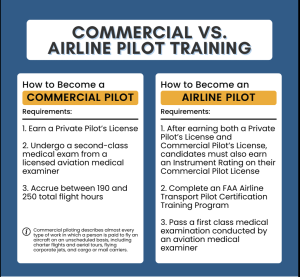
This is the comparison readers usually need most, and it helps avoid cannibalising the private article by making the distinction clear.
Private pilot
A private pilot is mainly trained for non-commercial flying. The focus is on building a safe flying foundation, learning aircraft handling, and developing the early judgment needed to operate an aircraft responsibly.
Commercial pilot
A commercial pilot moves beyond that stage into professional aviation. Flying is no longer just personal. It now sits inside a work environment where operational expectations, professional standards, and broader responsibilities apply.
Small comparison table
|
Area |
Private Pilot |
Commercial Pilot |
|---|---|---|
|
Main purpose |
Personal/non-commercial flying |
Professional / paid flying |
|
Training focus |
Foundational flying skills |
Professional operations and broader responsibility |
|
Operational environment |
Simpler personal flying context |
Structured and accountable professional setting |
|
Career value |
Entry milestone |
Career pathway |
That is the cleanest difference: private flying teaches the foundation, commercial flying turns that foundation into a profession.
Why Commercial Training Matters
The move into commercial aviation does not happen by accident. It requires structured development, formal qualification, and the willingness to treat flying as a serious profession rather than a casual interest.
Training shapes the professional pilot
This is why a Commercial Pilot License (CPL) – 200 H belongs naturally in this article. It represents the stage where aviation becomes more than ambition and starts becoming a practical professional direction. A commercial pilot needs more than enthusiasm. They need the training base that supports safe and credible progression.
Conclusion
Commercial flying comes with real rewards, but it also comes with real responsibility. A commercial pilot may transport passengers or cargo, support specialist aviation work, and operate in environments where preparation, coordination, and decision-making matter constantly. That is what separates the role from earlier training stages.
The real value of a career as a commercial pilot is not only the travel or the salary potential. It is the combination of progression, responsibility, challenge, and purpose. For the right person, that makes it one of the most rewarding paths in aviation.