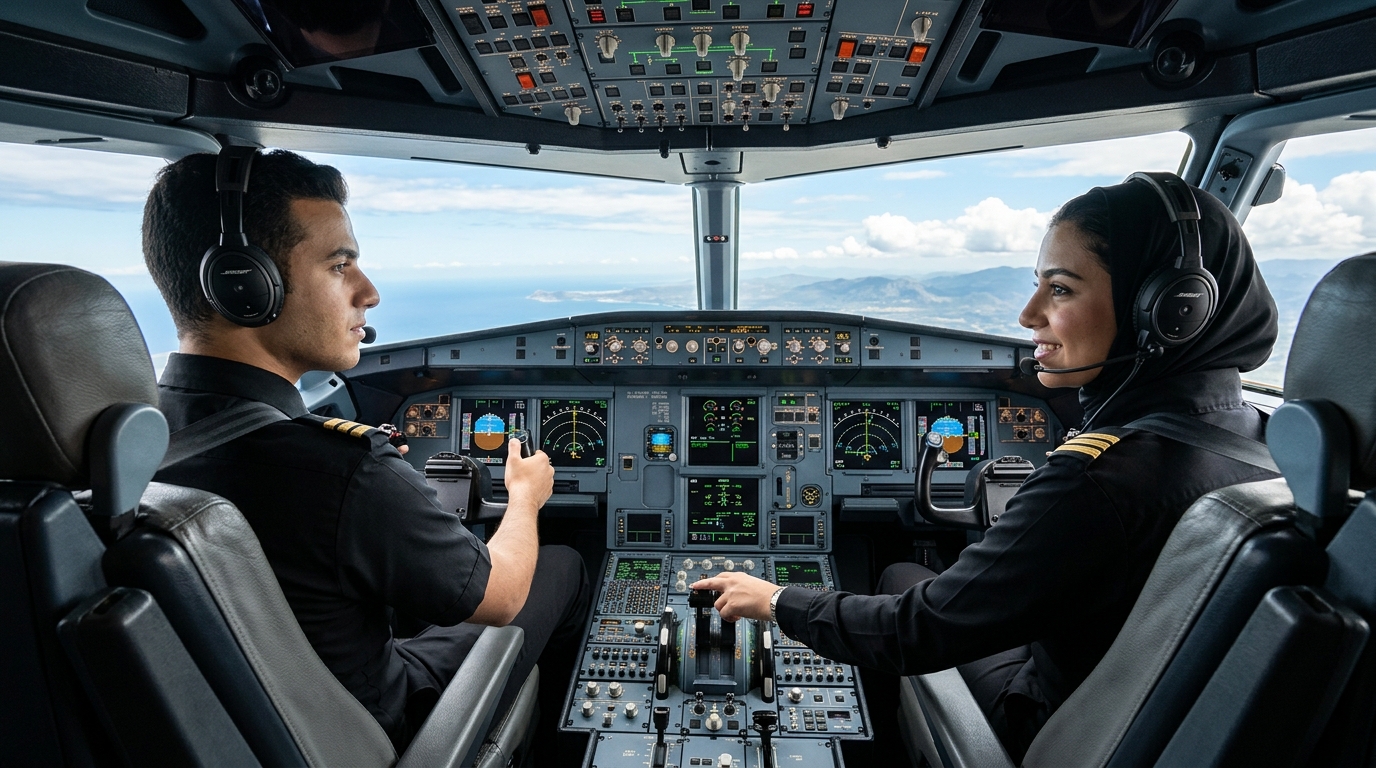
The cockpit is the nerve centre of any aircraft: the place where the captain and first officer manage the flight precisely and safely, from engine start to landing. With huge advances in technology, cockpits have changed from rooms packed with hundreds of complex analogue gauges into smart digital glass cockpits, where all the information appears on interactive electronic screens. If you want to learn each mechanical and digital gauge in detail, read our complete guide to the basic flight instruments and what they do; here, we take a practical look at how you are trained, as a student pilot, to manage this cockpit professionally.
For young men and women who want to enter civil aviation, the cockpit can look extremely complicated and confusing at first sight. In reality, every switch, screen and lever follows a carefully engineered layout (ergonomics) designed for easy reach and quick response, and the student learns it gradually and smoothly during practical and theory training.
How the Cockpit Evolved: From Analogue Gauges to the Glass Cockpit
For decades, pilots relied on the traditional set of six round gauges (known as the “six pack”), which measure speed, altitude, heading and the aircraft’s movement. Although these instruments are still used as important backups, the standard in modern commercial aviation has moved entirely to what is known as the “glass cockpit”.
A glass cockpit uses liquid crystal displays (LCD) that bring hundreds of vital data points together on two or three main screens in front of the pilots. This shift made the data simpler and clearer to read, which lowers the mental workload on the flight crew and lets them focus fully on navigation and sound decisions through every phase of the flight.
The Main Areas of a Modern Cockpit
Any modern civil aircraft cockpit is divided into clear functional areas, with each pilot responsible for specific tasks in controlling the aircraft:
- Primary Flight Display (PFD): sits directly in front of the pilot and shows the artificial horizon, airspeed, current altitude, rate of climb or descent, and compass heading on one unified visual display.
- Multi-Function Display (MFD): sits in the centre of the panel and shows flight maps, the flight plan, weather and surrounding terrain, as well as other aircraft’s tracks to avoid collisions.
- Engine monitoring and crew alerting systems (EICAS / ECAM): central screens showing oil pressure, engine temperature, fuel quantity and hydraulic systems, with instant visual and audio alerts if anything goes wrong.
- Overhead Panel: above the pilots’ heads, with the controls for electrics, air conditioning and pressurisation, fuel pumps and fire extinguishing, set before take-off and during the flight.
- Centre console (Pedestal): holds the thrust levers (throttles), flap levers and speed brakes, as well as the radio communication panels and navigation frequency selectors.
The Student Pilot’s Journey: How You Master the Cockpit Step by Step
A student does not start in the complex cockpit of a large passenger jet. Instead, they progress step by step through organised, proven stages of learning and training:
1. Ground Training and Basic Simulation
The student starts by understanding flight dynamics and aircraft systems in theory. Then they train on training panels and realistic simulators that help them memorise where switches and instruments are and master checklists until the procedures become automatic.
2. The Basic Trainer Cockpit (Private Pilot Licence, PPL)
Private Pilot Licence training takes between 3 and 6 months. The student learns the basics of controlling the aircraft, reading the flight indicators, and handling the control column and rudder pedals in real flight, building confidence inside the cockpit.
3. Advanced Training and Instrument Flying (Commercial Pilot Licence, CPL)
The student moves to faster, more advanced aircraft and trains in night flying and flying entirely by instruments (Instrument Rating) without looking out of the windows, so the cockpit and its screens become their real eyes in the air. By the end of this programme the student reaches about 200 hours of practical flying, qualifying them to fly commercially with skill and competence.
Comparison: Training Aircraft Cockpit vs Airliner Cockpit
The following table shows the main differences between the cockpit a student trains in at first and the one they work in after graduating and joining civil airlines:
| Point of comparison | Training aircraft cockpit (such as single-engine trainers) | Large commercial aircraft cockpit (Airbus / Boeing) |
|---|---|---|
| Seats and crew | Two side-by-side seats (student and instructor). | Two seats for the captain and first officer, plus extra observer seats (jump seats). |
| Control method | A control column (yoke or stick) mechanically linked to the control surfaces. | Smart electronic fly-by-wire control systems or advanced sidesticks. |
| Screens and systems | One or two main integrated screens with simple navigation equipment. | A set of interactive screens and a flight management computer (FMC/FMGS). |
| Flight management | Relies entirely on calculations and constant monitoring by the student and instructor. | Advanced autopilot systems and programmed navigation guidance for the whole route. |
The SkyTeam Aviation Programme: Professional Training That Takes You to the Front Seat
At SkyTeam Aviation Academy, we offer a complete programme that prepares civil pilots from the very start to the Commercial Pilot Licence (CPL) in about 18 months, including the Private Pilot Licence. Students receive their practical training at a flight school in South Africa approved by the South African Civil Aviation Authority (SACAA); South Africa is a member state of the International Civil Aviation Organization (ICAO), which has 193 member countries including Egypt.
The programme costs 46,000 USD plus registration fees, and this amount covers the full training programme including the scheduled exams. The registration fees also include the approved initial medical examination the academy organises in Egypt. As for payment, a first amount is paid in 3 instalments before travel, and the rest is paid over 12 months starting from the travel date, bringing the total payment period to about a year and a half from signing the contract. Our advisors confirm the amount of each payment.
While studying abroad, students live in a secure, furnished residential compound next to the study location, and the academy’s admission advisors give full details on housing and personal living expenses, which are separate from the study fees.
Licence Recognition and Jobs After Graduation
After finishing the programme in South Africa and obtaining the commercial pilot licence from SACAA, the student returns to Egypt to convert the licence smoothly through the Egyptian Civil Aviation Authority, sitting an exam in three specific subjects (Egyptian air law, meteorology and navigation). The Civil Aviation Authority sets the conversion fees under its approved regulations, and the admission advisor explains them to students.
One of the most important advantages for graduates is that the pilot licence issued by the Egyptian Civil Aviation Authority can be equated to a higher university qualification by the Supreme Council of Universities, under official decision no. 210 issued on 7 October 2024 under the universities law, provided the student holds the Thanaweya Amma or its equivalent. This lets the graduate go on to postgraduate study and enjoy the benefits of university graduates.
The academy also gives its graduates strong support in the job market: top students get the chance to work as flight instructors with the academy to build their flight hours, and graduates are supported in job interviews at about 10 different airlines, especially with the high and growing demand for pilots in Egypt and the Middle East.
Frequently Asked Questions About the Cockpit and Training
Do I need previous experience with instruments to enter the cockpit and start training?
No, flight training starts completely from zero. Applicants need no prior knowledge of instruments or flying; approved instructors explain every part of the cockpit gradually, from simple physical principles to the most precise modern navigation equipment.
What are the medical fitness requirements to sit in the cockpit as a commercial pilot?
The applicant takes a full medical examination in Egypt organised by the academy (at Hasabo International Hospital or through the medical commission of the Egyptian Civil Aviation Authority). The requirements include healthy eyesight with no eye conditions such as keratoconus or colour blindness, healthy hearing, and no chronic diseases or defects that could affect safety in flight. The final decision always rests with the official medical committee.
What is the minimum age and English requirement to start?
Students can apply early and start travel and study procedures under the age of 18 (from Grade 11 or Grade 10), and the Thanaweya Amma or its equivalent (American Diploma, IGCSE and others) is accepted. For English, the international minimum is Level 4 (ICAO Level 4, about B1), and the academy offers a dedicated 3-level English course for students who need to strengthen their skills before travel.
Does the academy offer cabin crew training alongside pilot training?
SkyTeam Academy specialises exclusively in training and preparing civil pilots for approved flying licences, and does not offer cabin crew training programmes.
Take Your First Step Toward the Cockpit with SkyTeam
The dream of sitting in the cockpit and flying a civil aircraft through the clouds starts with a sound decision and an approved academy that gives you a clear, internationally recognised learning path. We would be glad to welcome you at the academy’s office at 108 Hassan Maamoun Street, Nasr City, Cairo (Sunday to Thursday, 10 AM to 6 PM).
Contact our admission advisors today to learn the admission requirements, the papers you need such as the birth certificate and military deferment for those under 22, and the details of the next intakes, or visit the SkyTeam apply now page to take your first practical step toward the pilot’s seat.