
July 2026 · 5 min read · Sky Team Aviation Academy
Every year, thousands of students in Egypt search for “Egyptian Air Force College” and “Air Force Secondary School fees” when what they really want is one thing: to become pilots. But those two names lead to two completely different paths, and anyone who does not learn the difference early could lose a whole year on the wrong road. This guide explains the difference clearly and tells you which path fits your situation.
The difference between the Egyptian Air Force College and civil aviation in admission, study and career
- •The military path sits inside the armed forces and produces a military pilot officer with military service obligations.
- •The civil path is licensed professional training and ends with a pilot license that you own and use to work for civil airlines.
- •Not being accepted into the military path does not close the road to civil aviation, because the requirements are completely different.
- •On our civil path there is no required grade score. Passing Thanaweya Amma (secondary school certificate) is enough, and the age range is 17 to 30.
The Egyptian Air Force College and civil aviation compared in one table
| Aspect | Military path | Civil path |
|---|---|---|
| Institution | A military body within the armed forces | A civil flight school approved by a civil aviation authority |
| Outcome | Military pilot officer | An approved pilot license (PPL, then CPL) |
| Where you work | Within the military system | Civil airlines and commercial operations |
| Admission requirements | Announced by the military body and subject to its standards | With us: a secondary school pass, age 17-30, a medical exam, B2 English |
| Who owns the qualification | Tied to service inside the institution | The license is a qualification you own |
You won’t find the admission requirements or figures of any military body here. Each body sets these standards itself and they change, so any figure copied from them could be outdated or inaccurate. Go directly to the body for its current requirements.
The Air Force Secondary School in Egypt is a stage of schooling, not a pilot license
Many of the questions we receive start with the same sentence: my son wants to join the Air Force Secondary School, so how much are the fees? It’s a fair question, but before the figure comes a more important point. The Air Force Secondary School is a military secondary school that students join after finishing preparatory school (“prep”). In other words, it replaces the secondary school years inside a military system with its own rules. It is an educational path, not a flight training course, and it does not end with a pilot license.
None of this takes anything away from the school. It is a disciplined path with its own value and a body that sponsors it, and graduates continue inside the military system through its stages. But a family who imagines their son will leave the Air Force Secondary School with what he needs to work as a pilot straight away is relying on inaccurate information. A license is a completely different thing. A civil aviation authority issues it after actual flight hours, theory exams and an approved medical exam. No stage of schooling issues one, whatever its level.
Air Force Secondary School fees, grade score and requirements: who announces them and why they change
The Air Force Secondary School’s fees, the minimum grade score required after prep, the admission requirements and the benefits of studying there are all set by the body that runs the school. It publishes them in each year’s admission announcement, and they change from year to year depending on the number of applicants and that year’s rules. That is why you won’t find a figure here. Any number we write today could be out of date within months, and a decision built on an old number is a wrong decision.
Most of what circulates about the school’s fees and requirements is old posts and files that were re-uploaded with no date. Ask the body itself for the current year’s official admission announcement, and check the year it was issued before you base any step on it.
The civil path for the same student after secondary school
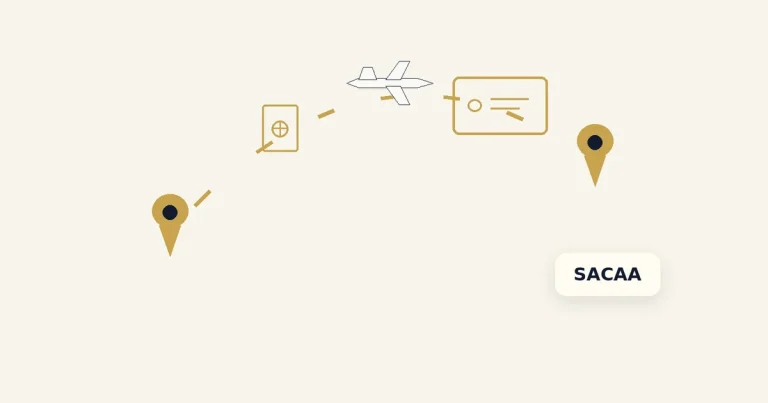
The civil path starts at a different point in age and in sequence: the student finishes regular secondary education, then begins flight training after getting the certificate. At SkyTeam the accepted age is 17 to 30 and there is no minimum grade score, so a pass is enough. Admission is open to students from the literary, science and mathematics streams. You need B2 English, equivalent to ICAO Level 4, and anyone below that level takes an English course first. Practical training takes place in South Africa under SACAA supervision.
Put simply, the two paths differ in the institution, the stage and the purpose, and each has requirements announced by whoever runs it. A family whose son could not get into the Air Force Secondary School, or who chose another route, has not had the door to flying closed.
If you are still in prep and looking for a way into aviation, the right path and what to do starting today are explained in our guide to flight school after prep. If you have already finished secondary school, you are at exactly the right age to start the civil path.
Leave your details
An admissions advisor will call you back within 24 hours.
Ready to apply? Apply now →
The Egyptian Air Force College, cabin crew, air traffic control and civil aviation
These four terms sound alike in Arabic but lead to completely different professions: the Egyptian Air Force College, cabin crew, air traffic control and civil aviation. Applicants mix them up all the time, and this is more than a matter of wording. Each path leads to a different job, a different training provider and a different license.
| Path | Nature of the work | What the training produces |
|---|---|---|
| Egyptian Air Force College | A military institution under the armed forces, where flying is a military mission within the service system | An air force pilot officer inside the military system |
| Cabin crew | Working in the passenger cabin: safety procedures and serving passengers during the flight | A flight attendant with a safety certificate and no flight hours |
| Air traffic control | Working from the control tower or a control center: directing aircraft and organizing their movement safely | An air traffic controller licensed by the aviation authority, working from the ground |
| Civil aviation | Flying civil passenger, cargo or training aircraft under a license from a civil aviation authority | A civil pilot license and actual flight hours that qualify you for the pilot’s seat |
Only the first and fourth paths put you in the pilot’s seat. The difference is that the first is military. You enter it through armed forces admission, under requirements and a system set by that body, and these change from year to year, so check them directly with the official source. The other is civil. You enter it through an aviation academy, after checking for yourself that the academy is approved by the civil aviation authority that will issue your license, and then you progress through hours and exams until you reach commercial work.
Cabin crew and air traffic control are professions entirely separate from flying the aircraft. Both are respected and in real demand, but training in them does not give you a single flight hour or a pilot license, and it does not later turn into a flying path. An air traffic controller works from the ground, a flight attendant works in the cabin, and each goes through training and a license of a completely different kind from a pilot’s.
SkyTeam trains for the civil aviation path only, and practical training takes place in South Africa under the supervision of the South African Civil Aviation Authority, SACAA. We do not train flight attendants or air traffic controllers. If your goal is cabin crew or air traffic control, you need a body that specializes in that path. We say so plainly to save you the time of applying to the wrong place.
How to choose between the military path and the civil path in Egypt
Choose the military path if your goal is military service itself and the military way of life, and you are ready for admission standards set by a military body and a long service commitment.
Choose the civil path if your goal is to fly for a civil airline, to own your license yourself, and to start as soon as you finish secondary school without waiting for an annual military admission cycle.
If you applied to the military path and were not accepted, this is not the end of the road. Many of our students came to us through exactly this door, because civil admission standards are completely different and have nothing to do with the result from any other body.
What an Egyptian Air Force College graduate does, and what a civil license holder does
An Egyptian Air Force College graduate becomes a pilot officer in the air force. The place of work is decided in advance: the military body chooses the squadron and base the graduate is assigned to, and the type of aircraft flown (fighter, transport, helicopter or trainer), according to its needs and not the graduate’s choice. Promotion follows the military rank ladder. The length and terms of the service commitment are governed by the body’s own regulations, and these details should be checked with the college directly because they change from year to year.
A civil license holder works for a commercial operator: an airline, a charter airline, an aerial work operator such as surveying and aerial photography, or a flight school as an instructor. The most important structural difference is that a civil license is a document its holder owns, issued in their name by a civil aviation authority. It is not a job with one employer. When a contract with one operator ends, the license stays with the pilot, who can take it to another operator as long as the license, the medical certificate and the periodic proficiency checks stay current.
Moving from military to civil aviation
The move is generally possible, but it is not automatic. Military experience alone does not turn into a civil license. The rules are set by the civil aviation authority in each country, and they vary by country and by case, depending on logged hours, aircraft type and the documents available. So the right way to handle this question is to ask the relevant civil aviation authority about your own situation, and not to rely on someone else’s experience.
Before you choose a path, ask three things: who decides where you fly and on which aircraft, whether what you end up with is a document in your name or a job title inside an institution, and what your commitments are after graduation. Pay differs by path and by operator, so it can’t be generalized.
How the civil path starts in practice from Egypt
The civil career path is continuous and ordered. You start with theory study and the Private Pilot License (PPL), then ratings (night flying, instruments and multi-engine), then the Commercial Pilot License (CPL), which is the license that lets you work as a pilot for pay. Theory study is in English, and our practical training is in South Africa under that country’s civil aviation authority (SACAA).
Admission requirements are covered in detail in our guide to aviation academy admission requirements in Egypt, license types and what they allow in the Private Pilot License guide, and fees and what they include on the civil aviation college fees page.
Frequently asked questions about the Egyptian Air Force College and civil aviation
What is the main difference between the Egyptian Air Force College and civil aviation?
The Egyptian Air Force College is a military path inside the armed forces, and it produces a military pilot officer with military service obligations. Civil aviation is a civilian professional path, and it produces an approved pilot license that qualifies you to work for civil airlines. The two paths differ in admission, study and career, and neither is a stage that comes before the other.
Is the Egyptian Air Force College free?
Admission systems and costs at military bodies are announced by those bodies, and we do not publish their figures here. What we can say clearly is that the military path is not a commercial one, while civil aviation is training you pay for, and you finish it with a license you own.
Can I become a civil aviation pilot if I was not accepted into the Egyptian Air Force College?
Yes. Not being accepted into a military path does not stop you from civil aviation at all, because the admission requirements are completely different. With us there is no required grade score, passing secondary school or its equivalent is enough, and the age range is 17 to 30.
Does a military license work in civil aviation?
Moving from military to civil aviation is generally possible but not automatic. It is subject to conversion rules set by the civil aviation authority, and these vary by country and by case. Check with the relevant authority in your country to find out what applies to you.
What about military service if I choose civil aviation?
For male students in Egypt, we handle the military service deferment procedures until age 25. This is available to students who enroll before turning 22.
Which is the faster way to the pilot's seat?
Our civil path is designed as one continuous professional path from the Private Pilot License to the Commercial Pilot License. The military path is governed only by the military body’s own admission and training plans, so the two can’t be fairly compared on time.
What grade score does the Egyptian Air Force College require?
The minimum grade score and admission requirements at any military body are announced by that body and change from year to year, so we do not publish a figure here that could be out of date. Go directly to the body. On our civil path there is no required grade score at all, and passing secondary school or its equivalent is enough.